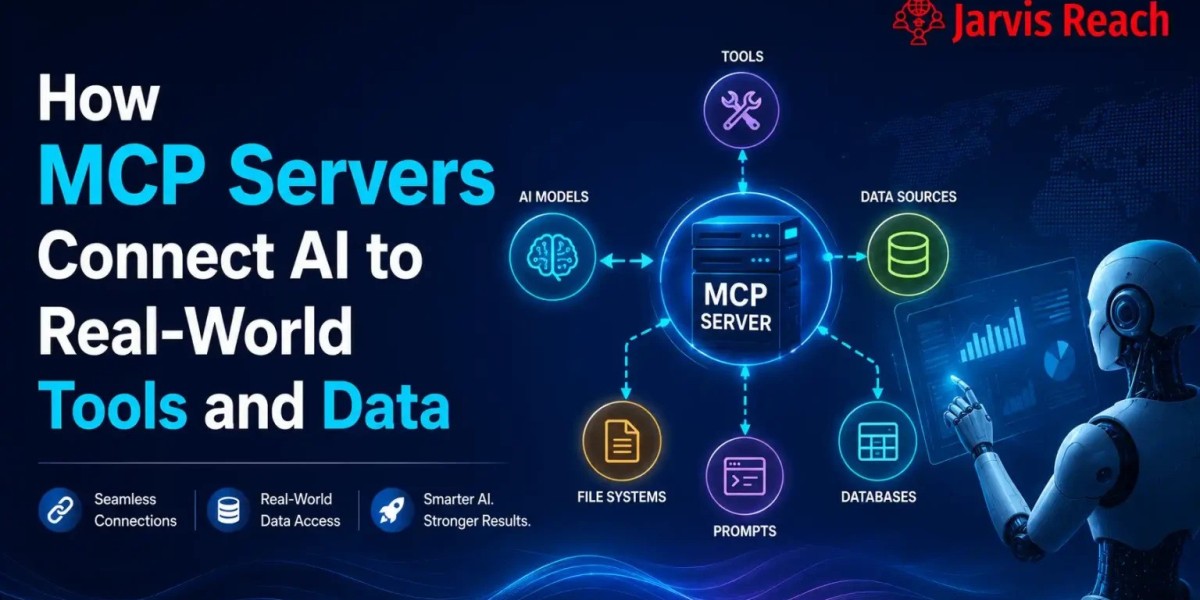

Artificial intelligence is evolving quickly, and businesses are using AI to automate tasks, improve customer experiences, and increase productivity. However, AI models become even more valuable when they can access real-time information from external systems. This is where an MCP Server plays a vital role. It enables AI platforms to securely connect with APIs, enterprise applications, SQL databases, file systems, and other external data sources.
Whether you are a developer, business owner, or AI enthusiast, understanding MCP Server can help you build intelligent, scalable, and secure AI applications. In this guide, you'll learn about MCP Client, APIs, enterprise data, authentication, prompt templates, backends, and the difference between stateful and stateless communication.
What Is an MCP Server?
An MCP Server (Model Context Protocol Server) is a server that allows AI applications to communicate with external tools and data sources using a standardized protocol. Instead of depending only on information stored inside the AI model, the server retrieves live data whenever it is required.
As a result, AI applications can provide accurate, up-to-date, and context-aware responses.
An MCP Server can connect AI with:
- APIs
- SQL databases
- Enterprise data
- File systems
- Business applications
- Internal software
- Cloud services
This makes AI significantly more useful in real-world environments.
Why Is MCP Server Important?
Modern businesses store information across multiple systems. Without an MCP Server, AI applications would need separate integrations for every service.
An MCP Server simplifies this process by acting as a central communication layer.
Its advantages include:
- Faster AI integration
- Secure data access
- Better automation
- Improved productivity
- Real-time information retrieval
Therefore, organizations can build powerful AI assistants without creating complex custom integrations.
How Does MCP Server Work?
The communication process follows a simple workflow.
- A user sends a request to an AI platform.
- The AI platform forwards the request through an MCP Client.
- The MCP Client communicates with the MCP Server.
- The server verifies authentication.
- The server retrieves information from APIs, SQL databases, or enterprise systems.
- The requested data is returned securely.
- The AI application generates an accurate response.
Because of this architecture, AI platforms always receive current information.
Understanding MCP Client
The MCP Client is responsible for connecting AI applications to the MCP Server.
Its responsibilities include:
- Sending requests
- Receiving responses
- Managing secure communication
- Accessing connected services
- Supporting AI workflows
Without the MCP Client, AI platforms cannot efficiently communicate with external resources.
API Integration
One of the biggest strengths of an MCP Server is seamless API integration.
APIs allow AI applications to communicate with external software, including:
- CRM platforms
- ERP systems
- Payment gateways
- Analytics tools
- Marketing software
- Customer support applications
Consequently, AI assistants can retrieve live information and complete business tasks automatically.
Enterprise Data Access
Every organization stores valuable enterprise data across multiple business applications.
An MCP Server provides secure access to:
- Customer records
- Employee information
- Sales reports
- Product catalogs
- Internal documentation
- Business analytics
As a result, AI applications can answer questions using the latest company information.
SQL Databases Support
Many organizations rely on SQL databases for structured information.
MCP Server enables AI platforms to:
- Search databases
- Generate reports
- Retrieve customer records
- Analyze business information
- Support decision-making
This improves efficiency while reducing manual database queries.
Multiple Data Sources
Modern AI applications often require information from different data sources.
MCP Server supports connections with:
- SQL databases
- REST APIs
- Enterprise software
- Cloud storage
- Internal applications
- Knowledge bases
- File systems
Therefore, AI assistants can combine information from multiple locations before generating responses.
Prompt Templates
Prompt templates help standardize AI communication and improve response quality.
Benefits include:
- Better consistency
- Faster automation
- Reduced prompt errors
- Easier workflow management
Organizations can reuse prompt templates across multiple AI applications.
Authentication and Security
Security is essential when AI accesses business systems.
MCP Server supports secure authentication methods, including:
- API Keys
- OAuth
- Access Tokens
- User Permissions
Strong authentication ensures that only authorized users can access protected enterprise data.
Stateful vs Stateless Communication
MCP Server supports both stateful and stateless architectures.
Stateless
A stateless server processes every request independently.
Advantages include:
- Better scalability
- Faster performance
- Simpler architecture
Stateful
A stateful server remembers previous interactions.
Benefits include:
- Personalized AI conversations
- Session continuity
- Better customer experiences
Businesses can choose the architecture that best fits their AI applications.
Backends and File Systems
An MCP Server can also communicate with application backends and file systems.
This allows AI to:
- Read business documents
- Search internal files
- Retrieve reports
- Process stored information
- Automate repetitive workflows
These integrations make AI assistants more powerful for enterprise use.
Benefits of MCP Server
Using an MCP Server provides several advantages:
- Secure AI communication
- API integration
- Enterprise data connectivity
- SQL database support
- Multiple data source integration
- Prompt templates
- Authentication management
- Backend connectivity
- File system access
- Scalable AI architecture
These features help organizations build reliable AI solutions for modern business environments.
Future of MCP Server
As AI adoption continues to grow, MCP Server will become increasingly important. Businesses require AI systems that can securely access real-time information, connect with multiple applications, and automate complex workflows.
Furthermore, future MCP implementations are expected to improve security, cloud integration, and enterprise scalability. This will allow developers to create even smarter AI assistants capable of handling complex business operations efficiently.
Conclusion
An MCP Server is the foundation of secure AI integration. It enables AI platforms to connect with APIs, enterprise data, SQL databases, file systems, and business backends through a standardized communication model. Combined with an MCP Client, authentication, prompt templates, and flexible stateful or stateless architectures, MCP Server helps organizations build intelligent, scalable, and future-ready AI applications capable of delivering accurate, real-time insights.