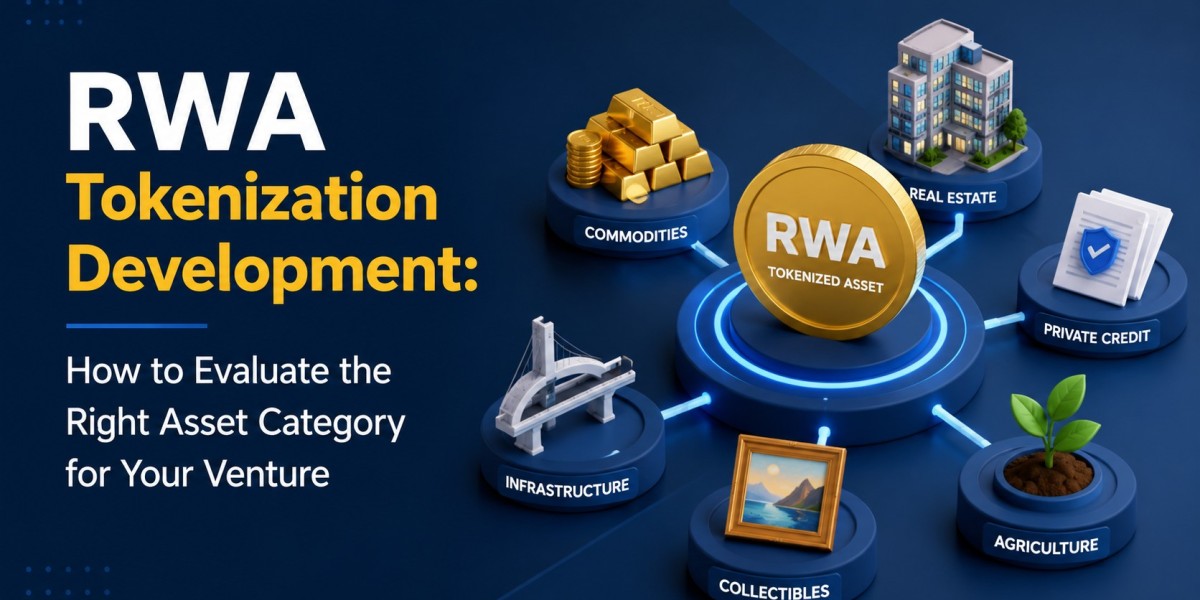

RWA Tokenization is changing how businesses approach ownership, investment, and trading of physical and financial assets. Instead of treating tokenization as a technology project alone, businesses now need to decide which asset category fits their commercial model, investor audience, legal structure, and operational capacity. Choosing an unsuitable asset can create problems with valuation, compliance, liquidity, custody, and investor demand even when the underlying technology works properly.
Real World Asset Tokenization covers a broad range of assets, including real estate, commodities, private credit, fine art, intellectual property, infrastructure, funds, and other financial interests. Each category has different requirements. A real estate token may require property valuation and legal ownership structures, while a private credit token may depend heavily on borrower quality, repayment terms, and servicing arrangements.
For this reason, RWA tokenization development should begin with asset evaluation rather than platform development. A venture that selects an asset category based on actual market demand and manageable operational requirements has a better basis for launching its tokenization model.
Why Asset Category Selection Matters
The asset category determines much of the business model behind a tokenization venture. It affects who can invest, how the asset is valued, what documents are required, how ownership is represented, and how investors may receive returns.
For example, real estate can offer rental income or appreciation, but property transactions often involve extensive legal documentation, valuations, taxes, and local regulations. Commodities may require storage, insurance, transportation records, and independent verification. Private credit may require continuous monitoring of borrowers and repayment schedules.
A business should therefore avoid choosing an asset simply because it appears popular in the tokenization market. The decision should consider whether the business can access reliable assets, verify ownership, maintain records, meet regulatory obligations, and create a reasonable investor proposition.
Step 1: Define the Venture's Investment Objective
The first method is to define what the venture wants investors to receive from the tokenized asset. Some platforms may focus on income-generating assets, while others may focus on capital appreciation, short-term trading, or portfolio diversification.
Income-focused ventures may consider rental properties, private credit, infrastructure projects, or revenue-generating businesses. Ventures seeking exposure to scarce physical assets could examine commodities, collectibles, or precious metals.
This objective should influence every later decision. If the business promises periodic income, the selected asset must have a reliable cash-flow mechanism. If the venture focuses on asset appreciation, valuation methodology and exit opportunities become more important.
Step 2: Examine Market Demand
Market demand is another practical method for selecting an asset category. A technically impressive tokenization platform may struggle if investors have little interest in the assets being offered.
Businesses can assess demand through investor surveys, existing market data, competitor research, search trends, private investment activity, and discussions with financial professionals. The objective is not simply to find the most discussed asset class. It is to identify a category where a genuine investment problem exists.
For example, investors may have difficulty accessing certain commercial properties because of high capital requirements. Tokenization can potentially divide economic interests into smaller units, subject to the applicable legal structure. In another case, investors may want access to private credit opportunities but need better digital administration and reporting.
Step 3: Assess Asset Ownership and Legal Rights
Ownership is one of the most important considerations in Real World Asset Tokenization. A digital token does not automatically represent legal ownership of an off-chain asset. The business needs a legal structure that connects the token holder's rights with the underlying asset or financial interest.
Before selecting an asset category, the venture should examine:
Who legally owns the asset?
What rights will token holders receive?
Can ownership or economic interests be divided?
What entity will hold the asset?
What documents establish the investor's rights?
Are transfers legally permitted?
What restrictions apply to investors?
Real estate, private funds, debt instruments, and physical commodities can each require different legal arrangements. Working with legal professionals familiar with securities, property, financial markets, and digital assets can help reduce structural uncertainty.
Step 4: Evaluate Asset Valuation
Every tokenized asset needs a credible method for determining its value. This becomes particularly important when assets do not have frequent public market prices.
Real estate may rely on professional property valuations, comparable transactions, rental income, and market conditions. Commodities can use established market prices, while private credit may depend on principal amounts, interest rates, borrower performance, and credit risk.
A venture should ask whether independent valuation data is available and how often the asset should be revalued. If valuation depends heavily on subjective estimates, the business may need additional controls and reporting processes.
Step 5: Check Liquidity Potential
Tokenization can create digital representations of asset interests, but it does not automatically create buyers. Liquidity depends on investor demand, transfer rules, market access, pricing, and the legal framework surrounding the token.
Businesses should examine how investors might exit their positions. Possible models can include platform-based transfers, approved secondary markets, scheduled redemption mechanisms, or asset sales.
An asset category with high theoretical value but limited buyer interest may not be suitable for a venture that depends on frequent trading. Businesses should therefore evaluate expected holding periods and likely secondary-market participation before selecting the asset.
Step 6: Review Regulatory Requirements
Regulatory treatment can vary according to the asset, investor type, jurisdiction, token structure, and rights attached to the token. This makes regulatory analysis an important part of RWA Tokenization Services.
A token representing an economic interest in real estate may receive different treatment from a token linked to a commodity or debt arrangement. Investor eligibility, offering rules, reporting requirements, custody, anti-money laundering procedures, taxation, and transfer restrictions may also differ.
A business should identify the jurisdictions in which it plans to operate before selecting the asset. Regulatory requirements should be assessed during the business planning stage rather than after the platform has been developed.
Step 7: Measure Asset Verification Requirements
Investors need reliable information about what a token represents. Physical and financial assets can require different verification methods.
For property, verification may involve ownership documents, property records, valuation reports, leases, insurance, and inspection records. For commodities, businesses may need storage records, certificates, audits, and custody information. For private credit, borrower documents, repayment records, financial statements, and servicing reports may be relevant.
The business should estimate the cost and frequency of these checks. If verification is too difficult or expensive, another asset category may provide a more practical starting point.
Step 8: Consider Cash Flow Characteristics
Cash flow can influence the attractiveness and complexity of an asset category. A token linked to a rental property may distribute rental income, while a private credit token may distribute interest and principal according to a repayment schedule.
Businesses should determine how income is generated, collected, calculated, and distributed. They should also identify what happens when payments are delayed or an asset underperforms.
This analysis helps the venture establish realistic investor expectations and determine the functions required within its platform.
Step 9: Compare Asset Categories
A useful method is to score potential assets against the same criteria instead of selecting one based on intuition.
A business can compare real estate, commodities, private credit, infrastructure, collectibles, funds, and other categories based on:
Market demand
Legal complexity
Regulatory requirements
Asset availability
Valuation frequency
Expected liquidity
Custody requirements
Income potential
Verification costs
Investor suitability
Operational workload
The highest-scoring category may not necessarily be the one with the highest projected return. The better choice is often the category that offers a reasonable balance between demand, compliance, operational feasibility, and commercial potential.
Asset Categories Worth Considering
Real Estate
Real estate remains an important category because properties can have measurable valuations and income potential. Residential, commercial, hospitality, industrial, and specialty properties can all be considered under different structures.
However, property tokenization involves local property law, ownership records, taxation, valuation, management, and investor rights. A business entering this category should have access to reliable properties and professional legal and property-management support.
Private Credit
Private credit can provide exposure to loans, receivables, and other debt arrangements. Tokenization can represent interests linked to these instruments, depending on the legal structure.
This category requires careful borrower assessment, repayment monitoring, credit analysis, and servicing. Ventures without financial risk-management experience may find this category more demanding than expected.
Commodities
Gold, precious metals, agricultural products, and other commodities can be considered for tokenization. The business must establish how the physical asset is stored, insured, audited, and linked to token supply.
The relationship between token quantity and underlying inventory needs to remain properly documented. Custody arrangements can become a significant part of the business model.
Infrastructure
Infrastructure projects may include energy facilities, transportation assets, utilities, and other long-term projects. These assets can potentially generate recurring revenues, but they often involve substantial legal, financial, technical, and operational requirements.
This category may be better suited to ventures with access to institutional projects and experienced project-management partners.
Art and Collectibles
Fine art, rare collectibles, luxury assets, and similar categories can attract investors interested in alternative assets. Yet valuation can be subjective, and market liquidity may differ substantially from conventional financial assets.
Authentication, insurance, physical custody, provenance records, and professional valuation are important considerations.
How Technology Requirements Change by Asset
The selected asset category also affects the design of the tokenization platform. A platform for real estate may require property information, investor records, income distribution, document management, and compliance workflows. A private credit platform may need loan schedules, repayment tracking, borrower information, and risk data.
During rwa tokenization platform development, businesses should therefore map asset requirements to platform functions. Token issuance, wallet management, investor onboarding, compliance checks, transaction records, reporting, and distribution mechanisms may be required across several categories, but their implementation can differ.
A suitable RWA tokenization development company can help map these requirements into a platform architecture. However, technology planning should follow the asset and legal model rather than dictate it.
Common Mistakes When Selecting an Asset
One frequent mistake is choosing an asset solely because it is receiving attention in the market. Popularity does not guarantee investor demand for a particular offering.
Another mistake is underestimating legal work. A token can be technically issued in a short period, but establishing enforceable rights around an underlying asset can require much more preparation.
Businesses can also underestimate operational requirements. Custody, valuation, audits, reporting, tax administration, investor support, and asset management may continue throughout the token's lifecycle.
Selecting an asset with unclear ownership records or unreliable valuation data can create additional problems. A venture should examine these issues before committing development resources.
Role of an RWA Tokenization Company
An experienced RWA Tokenization Company can support businesses across asset assessment, token structure, platform planning, smart contract development, compliance integration, investor workflows, and launch preparation.
The right technology partner should understand that different asset categories require different workflows. Businesses should evaluate a provider based on its technical experience, understanding of token standards, integration capabilities, security practices, compliance support, and experience with asset-specific requirements.
RWA tokenization development services may include smart contract creation, token issuance modules, investor dashboards, wallet integration, asset management features, compliance workflows, payment distribution, and secondary trading functionality.
Creating an Asset Selection Scorecard
A simple scorecard can make the decision easier. Each candidate asset can receive a score from one to five across several categories, such as legal feasibility, investor demand, liquidity, valuation reliability, asset availability, operational requirements, and revenue potential.
For example, a venture comparing commercial property, gold, and private credit can assign weighted scores according to its business objectives. Legal feasibility may receive a higher weight than projected returns if regulatory certainty is the venture's primary concern.
This approach reduces subjective decision-making and gives founders a documented reason for selecting a particular category.
Preparing for RWA Token Development
Once an asset category has been selected, the venture can move toward RWA token development. The next stage should define the legal rights represented by the token, ownership structure, token economics, investor eligibility, custody model, valuation process, compliance requirements, and platform functions.
The business can then prepare technical specifications for smart contracts and the wider platform. Testing should cover token issuance, transfers, investor onboarding, payments, permissions, reporting, and other relevant workflows.
A phased launch can also help the venture test investor interest before expanding into additional asset categories.
Conclusion
Selecting the right asset category is one of the first major decisions in a tokenization venture because the asset influences legal structure, investor demand, valuation, liquidity, custody, compliance, cash flow, and platform requirements. Businesses should assess these factors before committing to development and compare several categories using a consistent scoring method. Real estate, private credit, commodities, infrastructure, and collectibles each offer different opportunities and operational challenges. The right choice depends on the venture's target investors, available assets, regulatory environment, financial model, and operational capacity rather than market popularity alone. Once the asset category is established, businesses can plan their technology and token structure around genuine asset requirements. Blockchain App Factory provides RWA tokenization development services covering the technology requirements involved in creating and launching tokenized asset ventures.
FAQs
1. What is RWA Tokenization?
RWA Tokenization refers to representing ownership rights or economic interests in real-world assets through blockchain-based tokens. The underlying assets can include real estate, commodities, credit instruments, infrastructure, art, and other asset types.
2. Which asset category is best for RWA Tokenization?
There is no single asset category that works for every venture. The selection should consider investor demand, legal requirements, valuation, liquidity, asset availability, cash flow, and operational requirements.
3. Why is real estate commonly considered for Real World Asset Tokenization?
Real estate can provide identifiable assets, established valuation methods, rental income, and potential investor demand. However, property law, ownership structures, taxes, management, and local regulations need to be assessed before launch.
4. What do RWA Tokenization Services usually include?
RWA Tokenization Services can include asset structuring, token design, smart contract development, investor onboarding, compliance functions, wallet integration, asset management, payment distribution, reporting, and platform development.
5. What should businesses check before choosing a tokenization asset?
Businesses should review ownership rights, market demand, valuation methods, liquidity, legal restrictions, regulatory requirements, custody, verification procedures, income potential, and ongoing management costs.
6. What is the role of an RWA tokenization development company?
An RWA tokenization development company can provide technical support for token creation, smart contracts, investor interfaces, compliance workflows, asset management modules, wallet connections, payment functions, and other platform components.
7. How does rwa tokenization platform development depend on the asset?
Different assets require different platform functions. A property platform may need rental distribution and property records, while a credit platform may require repayment schedules, borrower information, and loan monitoring.
8. Is RWA tokenization suitable for startups?
It can be suitable for startups that have access to appropriate assets, a defined investor market, a workable legal structure, and sufficient resources for compliance and operations. Starting with a focused asset category can help limit initial complexity.
9. What are RWA tokenization development services?
RWA tokenization development services refer to technical services used to create tokenized asset platforms, including smart contracts, token issuance, investor dashboards, wallets, compliance workflows, transaction management, and related integrations.
10. What is RWA Tokenizaion development?
RWA Tokenizaion development refers to the process of creating blockchain-based systems for representing real-world assets through digital tokens. The process usually combines asset structuring, legal planning, smart contract development, platform engineering, and investor management.