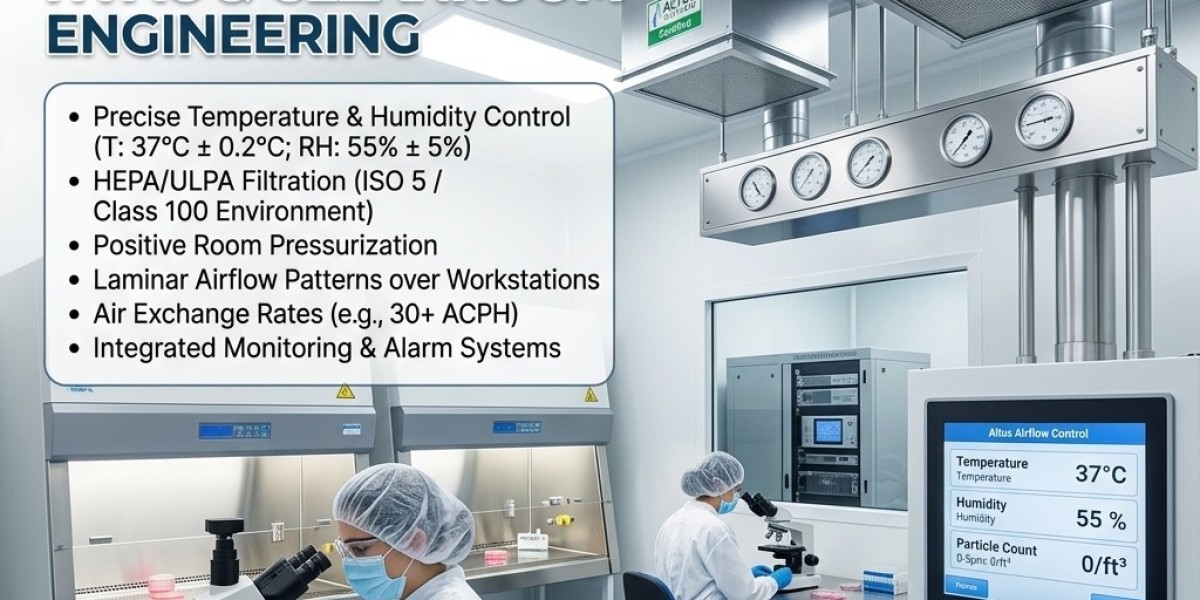

INTRODUCTION
Cleanroom technology plays a critical role in IVF Laboratory Design because assisted reproductive technology requires carefully controlled environmental conditions for sensitive biological procedures. Embryos, gametes, culture media, and laboratory processes can be affected by airborne particles, microorganisms, volatile organic compounds, temperature fluctuations, humidity changes, and other environmental factors. A properly planned cleanroom environment helps control these risks through filtration, HVAC systems, controlled airflow, suitable materials, zoning, pressure management, and environmental monitoring. By integrating cleanroom principles into laboratory planning, fertility centres can create a stable, hygienic, and efficiently organized environment for embryology and related procedures.
Unlike a conventional laboratory, an IVF laboratory requires greater attention to environmental stability and contamination prevention. Cleanroom technology therefore needs to be considered from the earliest stages of planning rather than added after construction. The design should connect architectural elements, HVAC engineering, laboratory workflow, equipment placement, personnel movement, and contamination-control procedures into one coordinated system.
What Is Cleanroom Technology?
Cleanroom technology refers to the engineering methods used to control environmental conditions within a specialized space.
These conditions can include:
- Airborne particulate levels
- Microbial contamination
- Temperature
- Relative humidity
- Air pressure
- Airflow direction
- Air changes
- Filtration
- Surface cleanliness
- Personnel movement
The objective is to create a controlled environment appropriate for the activities performed inside the laboratory.
In an IVF facility, cleanroom technology can be incorporated into areas such as:
- Embryology laboratories
- Andrology laboratories
- IVF procedure support areas
- Media preparation areas
- Cryopreservation areas
- Sample processing areas
- Laboratory storage areas
The precise environmental requirements should be established according to the laboratory's processes, applicable regulations, equipment specifications, and professional guidance.
Why Is Cleanroom Technology Important in IVF Laboratories?
IVF laboratories handle highly sensitive biological material.
Environmental contamination can potentially affect laboratory processes and the quality of the working environment. Even small amounts of airborne particles or chemical contaminants can be undesirable in sensitive laboratory areas.
Cleanroom technology supports:
- Contamination control
- Environmental stability
- Controlled airflow
- Particle reduction
- Improved hygiene
- Consistent laboratory conditions
- Better workflow management
- Protection of sensitive processes
It should be viewed as one component of an overall quality-management and laboratory-control strategy.
1. HVAC Systems Provide Environmental Stability
HVAC is one of the most important components of cleanroom engineering.
An appropriately designed HVAC system helps control:
- Temperature
- Humidity
- Fresh air
- Air distribution
- Air filtration
- Pressure relationships
- Air changes
Temperature stability is particularly important because laboratory equipment and biological processes may require controlled environmental conditions.
A properly engineered HVAC system helps maintain consistent conditions throughout the laboratory.
2. HEPA Filtration Helps Control Airborne Particles
High-efficiency particulate air filtration can be used as part of the air-cleaning strategy in controlled laboratory environments.
HEPA filtration can help reduce airborne particulate contamination by filtering particles from supplied air.
A cleanroom HVAC system may incorporate:
- HEPA filters
- Filter housings
- Supply plenums
- Air-handling units
- Ductwork
- Monitoring systems
Filter selection and performance requirements should be determined according to the laboratory's specific design criteria.
3. Controlled Airflow Supports Contamination Management
Air movement is an important part of cleanroom planning.
The airflow design should help prevent uncontrolled movement of contaminants between areas.
Depending on the facility design, airflow planning can involve:
- Supply-air distribution
- Return-air locations
- Air changes
- Pressure relationships
- Airflow direction
- Zoning
The objective is to establish predictable air movement rather than allowing uncontrolled circulation.
4. Laboratory Zoning Reduces Cross-Contamination Risks
Zoning is another major cleanroom principle.
An IVF facility can be divided into areas according to their cleanliness requirements and functions.
For example, planning may distinguish between:
- Public areas
- Staff areas
- Sample handling areas
- Embryology areas
- Andrology areas
- Support spaces
- Storage areas
- Utility spaces
The exact zoning arrangement should be developed according to the laboratory workflow.
Effective zoning reduces unnecessary movement between areas and supports controlled personnel and material flow.
5. Pressure Relationships Help Control Air Movement
Pressure differentials can be incorporated into cleanroom planning to influence the direction of airflow between adjoining spaces.
Depending on the design, controlled pressure relationships may help prevent less-controlled air from moving into more critical areas.
Pressure monitoring systems can provide information about:
- Room pressure
- Pressure differentials
- HVAC performance
- Airflow conditions
The pressure strategy should be established through engineering calculations and verified during commissioning.
6. Cleanroom Materials Improve Hygiene
The materials selected for an IVF laboratory should support cleaning and contamination control.
Common considerations include:
- Smooth surfaces
- Non-porous finishes
- Easy-to-clean wall systems
- Sealed joints
- Hygienic ceilings
- Suitable flooring
- Chemical-resistant surfaces
Surfaces should minimize areas where dust, moisture, or contaminants can accumulate.
Material selection should also consider compatibility with cleaning and disinfection procedures.
7. Modular Construction Supports Controlled Environments
Modular cleanroom construction can provide controlled and hygienic interior finishes.
Depending on the specification, modular systems may include:
- Insulated wall panels
- Cleanroom ceiling panels
- Sealed doors
- Viewing windows
- Service panels
- Hygienic flooring
The objective is to create a continuous and cleanable environment with appropriately sealed interfaces.
8. Controlled Personnel Movement
People are a major potential source of particulate contamination.
Cleanroom planning therefore considers how staff enter, move through, and exit controlled areas.
Measures may include:
- Gowning areas
- Change rooms
- Controlled entrances
- Airlocks where appropriate
- Defined personnel pathways
- Access restrictions
The layout should minimize unnecessary movement and support the laboratory's operating procedures.
9. Material Movement Requires Careful Planning
Materials entering an IVF laboratory should also follow controlled pathways.
Examples include:
- Laboratory supplies
- Culture media
- Consumables
- Samples
- Equipment
- Cleaning materials
The design can establish dedicated or controlled routes for materials to reduce unnecessary cross-traffic.
This is particularly important in facilities where several laboratory functions operate close together.
10. VOC Control Is an Important Consideration
Volatile organic compounds can originate from:
- Construction materials
- Adhesives
- Paints
- Cleaning products
- Furniture
- Sealants
- Laboratory supplies
Because IVF laboratories contain sensitive biological processes, material selection and ventilation strategies should consider potential chemical emissions.
Low-emission materials can be considered during construction.
The facility should also establish appropriate cleaning and maintenance procedures.
11. Temperature and Humidity Monitoring
Environmental monitoring provides ongoing information about laboratory conditions.
Systems may monitor:
- Temperature
- Relative humidity
- Room pressure
- Air quality
- HVAC performance
- Other project-specific parameters
Continuous or periodic monitoring can help identify environmental deviations before they become persistent problems.
Alarm systems may also be incorporated where appropriate.
12. Cleanroom Design Supports Laboratory Workflow
Cleanroom technology is not only about filtration.
It should be integrated with the laboratory workflow.
A well-planned IVF facility considers the movement of:
- Patients
- Embryologists
- Laboratory technicians
- Samples
- Consumables
- Equipment
Workflow planning can reduce unnecessary movement and improve operational efficiency.
13. Equipment Placement Must Be Considered
Laboratory equipment can affect airflow and space utilization.
Equipment may include:
- Incubators
- Microscopes
- Laminar airflow workstations where specified
- Cryopreservation systems
- Centrifuges
- Micromanipulation systems
- Laboratory refrigerators
- Monitoring equipment
The design should consider equipment dimensions, utility connections, maintenance access, heat generation, and personnel working space.
Equipment should not be positioned in a way that unnecessarily interferes with intended airflow patterns.
14. Embryology Laboratory Design Requires Special Attention
The embryology laboratory is one of the most sensitive areas within an IVF facility.
Design considerations may include:
- Environmental stability
- Controlled access
- Appropriate filtration
- Temperature control
- Humidity control
- Suitable surfaces
- Equipment positioning
- Workflow
- Monitoring
The design should support embryologists in performing delicate procedures with minimal unnecessary movement.
15. Andrology Laboratory Planning
The andrology laboratory also benefits from appropriate zoning and environmental control.
Depending on its functions, it may include areas for:
- Sample processing
- Semen analysis
- Preparation procedures
- Storage
- Laboratory equipment
The relationship between andrology and embryology areas should be considered when developing the overall laboratory workflow.
16. Cryopreservation Area Considerations
Cryopreservation areas require specialized equipment and safety planning.
The design should consider:
- Cryogenic equipment
- Storage systems
- Ventilation
- Monitoring
- Emergency access
- Staff movement
- Safety procedures
Environmental engineering and laboratory safety requirements should be addressed together.
17. Airflow Monitoring and Testing
Installing HVAC equipment is only the beginning.
After installation, the system should be evaluated to confirm that it performs according to the approved design.
Testing can include:
- Airflow measurements
- Air velocity measurements
- Pressure differential testing
- Temperature verification
- Humidity verification
- Filter integrity testing where applicable
- Particle measurements where specified
These activities help establish whether the cleanroom environment is operating as intended.
18. Validation and Commissioning
Validation and commissioning provide important evidence that installed systems meet their specified requirements.
Documentation can include:
- Equipment records
- HVAC test results
- Filter test reports
- Airflow reports
- Pressure readings
- Environmental monitoring records
- Commissioning documentation
The exact validation protocol should be developed according to the facility's design criteria and applicable requirements.
19. Cleaning and Maintenance Planning
Cleanroom technology is effective only when supported by proper maintenance.
Maintenance programs may include:
- HVAC inspection
- Filter replacement
- Airflow checks
- Environmental monitoring
- Surface inspections
- Cleaning procedures
- Preventive maintenance
A preventive maintenance schedule helps maintain consistent system performance.
20. Benefits of Integrating Cleanroom Technology Into IVF Design
A well-integrated cleanroom strategy can provide several benefits.
Improved Contamination Control
Controlled airflow and filtration can help reduce unwanted airborne contamination.
Environmental Stability
HVAC systems help maintain specified temperature and humidity conditions.
Better Workflow
Zoning and controlled movement can improve laboratory efficiency.
Improved Hygiene
Suitable surfaces and modular finishes support effective cleaning.
Better Monitoring
Environmental monitoring provides information about laboratory conditions.
Easier Maintenance
Well-planned systems can provide better access to filters, equipment, and utilities.
Long-Term Reliability
Proper engineering, testing, and maintenance can support consistent facility performance.
Cleanroom Technology and IVF Laboratory Efficiency
A cleanroom should not be designed independently from laboratory operations.
For example, placing frequently used equipment far from workstations may create unnecessary staff movement. Similarly, poorly positioned air returns or equipment can interfere with intended airflow patterns.
Integrated planning considers:
- Workflow
- Equipment
- Airflow
- Utilities
- Personnel
- Materials
- Maintenance
- Safety
This creates a more functional laboratory environment.
Role of Documentation
Documentation is an important part of a professionally engineered IVF laboratory.
Project documentation may include:
- Approved drawings
- HVAC calculations
- Equipment specifications
- Material specifications
- Testing reports
- Validation records
- Maintenance instructions
- Operating procedures
Complete documentation makes future maintenance and modifications easier.
Future-Ready Cleanroom Design
IVF technology continues to evolve, so laboratories should consider future requirements during the initial design.
Future-ready planning can include:
- Flexible utility arrangements
- Expandable HVAC capacity
- Additional monitoring points
- Adaptable workspaces
- Equipment replacement access
- Modular expansion possibilities
This can help facilities adapt without requiring major structural changes.
Importance of Professional Engineering
Cleanroom technology involves multiple engineering disciplines.
A professionally designed IVF laboratory may require coordination between:
- Architects
- HVAC engineers
- Cleanroom specialists
- Electrical engineers
- Medical gas professionals
- Biomedical teams
- IVF laboratory specialists
- Infection-control professionals
Coordination is important because a change to one system can affect another.
For example, changing the ceiling arrangement can affect HEPA filter placement, lighting, airflow, and equipment locations.
Conclusion
Cleanroom technology supports IVF Laboratory Design by creating a controlled environment in which temperature, humidity, airflow, filtration, pressure, cleanliness, workflow, and contamination risks can be systematically managed. HVAC systems, HEPA filtration, hygienic materials, zoning, controlled personnel movement, environmental monitoring, testing, and validation all contribute to a reliable laboratory environment. Effective cleanroom planning should begin during the design stage and continue through installation, commissioning, operation, and preventive maintenance. By combining cleanroom engineering with practical laboratory workflow and future expansion planning, fertility centres can develop efficient, controlled, and adaptable IVF facilities. Altus Airflow provides specialized solutions for healthcare and controlled-environment infrastructure, supporting the planning and execution of modern IVF laboratory environments.
Frequently Asked Questions
1. How does cleanroom technology support IVF Laboratory Design?
Cleanroom technology helps IVF Laboratory Design control airborne particles, airflow, temperature, humidity, pressure, filtration, and contamination risks. These controls support a stable environment for sensitive IVF laboratory processes.
2. Why is HVAC important in IVF Laboratory Design?
HVAC systems help IVF Laboratory Design maintain controlled temperature, humidity, fresh-air supply, filtration, airflow distribution, and pressure relationships required by the facility's engineering specifications.
3. Does HEPA filtration form part of cleanroom technology?
Yes. HEPA filtration can be incorporated into controlled laboratory HVAC systems. In IVF Laboratory Design, appropriate filtration can help reduce airborne particulate contamination when designed and maintained according to the facility's requirements.
4. How does zoning help IVF laboratory contamination control?
Zoning separates laboratory functions according to workflow and environmental requirements. Proper zoning in IVF Laboratory Design can reduce unnecessary personnel and material movement between areas and help manage contamination risks.
5. What materials are suitable for an IVF cleanroom?
Suitable materials generally provide smooth, durable, non-porous, and easy-to-clean surfaces. In IVF Laboratory Design, wall, ceiling, flooring, doors, and sealants should be selected according to hygiene, cleaning, chemical compatibility, and project requirements.
Read Our Previous Blog------>How long do Modular Ophthalmic OT Manufacturers take to complete an installation project?