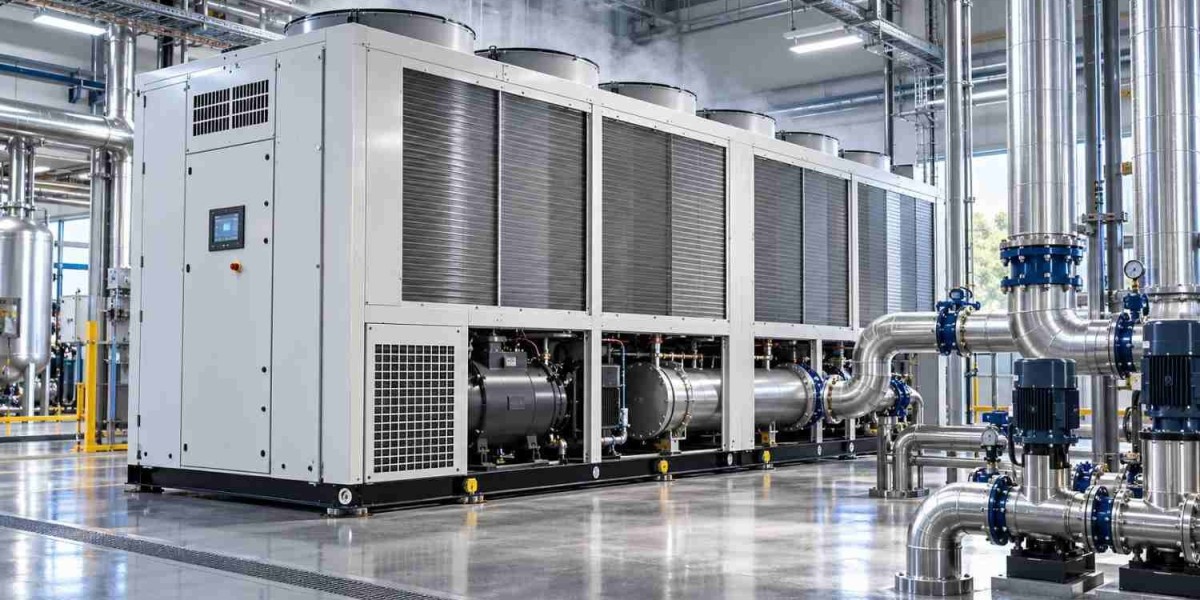

Every plant engineer we've quoted for eventually asks the same question: why not just go with whatever's cheapest and matches the tonnage? A screw chiller costs more upfront than several alternatives, and that price gap is exactly why buyers need a real answer, not a sales pitch. The honest case for a screw chiller isn't about being the newest technology. It's about matching equipment to a duty cycle that punishes anything built for intermittent use.
Screw Chiller vs. the Alternatives You're Actually Comparing It To
Most buyers aren't choosing screw chillers in isolation — they're comparing them against three other technologies, and the comparison only makes sense once you separate duty cycle from tonnage.
Screw vs. Reciprocating Chillers
Reciprocating chillers handle smaller loads economically but wear faster under continuous cycling — piston-driven compressors have more moving parts exposed to that stress. Screw chillers hold up better past the 50 TR mark specifically because rotary compression puts less mechanical stress on continuous-duty operation.
Screw vs. Centrifugal Chillers
Centrifugal units win at very large tonnage — typically above 500 TR — but they lose efficiency fast at partial load, which is exactly where most industrial plants actually operate most of the time.
The Detail Buyers Skip
Minimum load ratio. A screw chiller with a poor minimum load ratio will short-cycle just as badly as a reciprocating unit if your plant's baseline demand sits well below its rated capacity. Ask for this number specifically — it rarely appears on standard spec sheets.
Benefits That Justify the Higher Upfront Cost
A screw chiller earns its price premium in specific, measurable ways — not through vague quality claims.
Longer service intervals than reciprocating alternatives reduce planned maintenance costs over the equipment's lifespan.
Better partial-load efficiency than centrifugal units at typical industrial demand levels, protecting your energy budget.
Fewer catastrophic failure points, since rotary compression avoids the piston and valve wear that causes sudden reciprocating chiller breakdowns.
Higher tonnage flexibility than reciprocating units without jumping straight to centrifugal-scale investment.
Reduced downtime risk during peak production periods when a chiller failure costs more than any maintenance contract.
Resale and retrofit value, since screw chiller components are more standardized across manufacturers than centrifugal systems.
Why Sourcing Location Affects Your Total Decision, Not Just Your Delivery Date
We're based in India, and that location shapes more of this decision than buyers initially expect. As screw chiller manufacturers in India, we can turn around custom tonnage configurations faster than most exporters shipping from further afield, which matters when a plant expansion timeline doesn't leave room for a three-month lead time. Buyers comparing screw chiller suppliers in India against imported alternatives should weigh spare parts availability just as heavily as the initial unit cost — a screw chiller dealer in India with local stock beats an overseas exporter every time a compressor part fails on a Friday. That's not patriotism. That's a supply chain fact.
About Us
We're Aquatech Plus, and we turned down a large reciprocating-chiller order in 2022 because the client's continuous three-shift operation would have burned through that equipment within four years. We told them to spec a screw chiller instead, at a higher upfront cost, and they pushed back before eventually agreeing. That client is still running the same unit today. We'd rather lose a quick sale than watch someone replace equipment twice.
Ready to Compare Chiller Options for Your Plant?
Send us your load profile, shift pattern, and site constraints, and we'll tell you honestly whether a screw chiller is the right fit — or whether it isn't. Minimum order quantity is one unit, and we typically respond with a technical recommendation within 48 hours. Reach Aquatech Plus through www.aquatechplus.com to start the comparison.
Conclusion
Choosing a screw chiller isn't about picking the most advanced option on the market — it's about matching compressor technology to how your plant actually runs, shift after shift. The right screw chiller pays for its premium through fewer failures and lower energy cost at partial load, not through a spec sheet that only looks good at 100%. That's the calculation worth running before any purchase order goes out.
FAQs
Is a screw chiller always better than a reciprocating chiller?
No. Below roughly 40 TR with intermittent duty cycles, a reciprocating unit is often more cost-effective. Screw chillers earn their premium specifically at higher tonnage and continuous operation.
What tonnage range makes the most sense for screw chiller manufacturers to recommend over centrifugal units?
Generally 40 TR to 500 TR, though the crossover point shifts based on partial-load requirements. Above that range, centrifugal efficiency typically wins.
Do screw chiller suppliers in India offer financing or leasing options?
Some do, but it varies considerably according to the size of the supplier. Many smaller regional equipment dealerships don‘t, but many of the bigger producers are partnering with equipment finance companies.
How long does a screw chiller typically last compared to alternatives?
15 to 20 years with normal wear as well as occasional repairs, normally last several years longer than reciprocating units would for the same continuous duty conditions, as long as the equipment is maintained.
Can a screw chiller dealer help retrofit an existing plant instead of a full replacement?
Related to 2, some retrofits are never feasible they require advanced production tools, or pose insurmountable electrical/piping constraints. Other times, a retrofit can be in theory less expensive than a fully denitrated new unit, but a site assessment is needed to determine the costs of the specific retrofit before B can be assumed to be true.