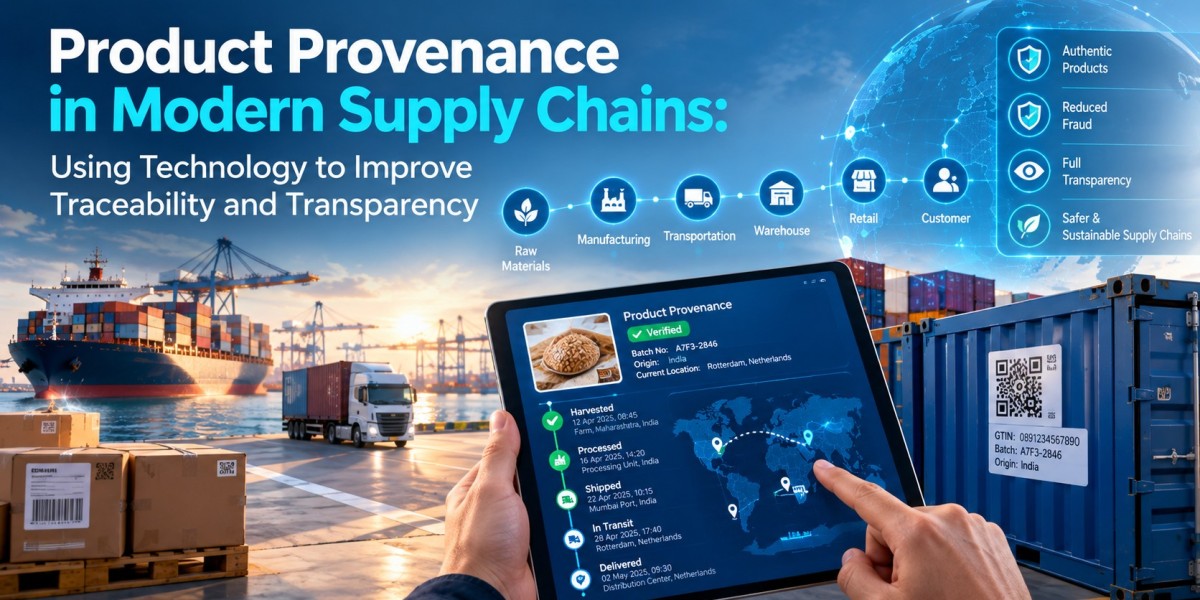

Supply chains are becoming more complex, global, and interconnected. A single product can involve raw materials from multiple suppliers, manufacturing across different locations, transportation through several logistics networks, and distribution across multiple markets.
With such complexity, businesses increasingly need to understand where products come from, how they move through the supply chain, and what happens at each stage.
This is where product provenance and digital traceability become increasingly valuable.
What Is Product Provenance?
Product provenance refers to the ability to understand and document the history and origin of a product or material.
Depending on the industry, provenance information can include:
- Source of raw materials
- Supplier information
- Manufacturing location
- Production dates
- Quality checks
- Transportation records
- Warehouse movements
- Distribution information
- Product certifications
Technology can help organizations collect and connect this information throughout the product lifecycle.
Why Traceability Matters
Without effective traceability, businesses may struggle to determine where a particular product came from or how it moved through the supply chain.
This can create challenges during quality investigations, recalls, compliance checks, supplier assessments, and customer inquiries.
Digital traceability can make this information easier to access and analyze.
Creating a Connected Product Journey
Modern traceability platforms can connect information from multiple systems.
For example, supplier information can be connected with manufacturing data, warehouse records, shipment details, and customer orders.
This creates a digital record of the product journey.
The objective is not simply to collect more data but to make the information useful when organizations need it.
The Role of IoT
IoT devices can contribute to traceability by collecting information throughout logistics operations.
Sensors can track location, temperature, humidity, movement, and other conditions.
This can be particularly valuable for industries where product conditions matter during transportation and storage.
For example, temperature-sensitive goods may require continuous monitoring throughout their journey.
Blockchain and Distributed Records
Blockchain technology is sometimes considered for supply chain traceability because it can provide a shared digital record across participating organizations.
However, technology selection should depend on the specific business requirement.
A centralized database, cloud platform, API-based architecture, or distributed ledger may each be appropriate for different use cases.
The most important factor is creating reliable and accessible supply chain information.
AI and Product Traceability
AI can help organizations analyze large amounts of traceability data.
For example, AI systems may identify unusual supplier patterns, missing records, inconsistent shipment information, or potential quality issues.
AI can also help organizations analyze information across multiple supply chain stages.
This can make traceability systems more useful for operational decision-making.
Connecting Traceability With Digital Supply Chains
Traceability works best when connected to broader digital supply chain solutions.
If supplier, manufacturing, warehouse, transportation, and customer information is stored in separate systems, creating a complete product history can be difficult.
Integration allows information to move between systems and provides organizations with a more connected view.
The Role of Logistics Software Development
Many businesses require customized traceability workflows.
A logistics software development company can help organizations integrate ERP, WMS, TMS, supplier platforms, IoT systems, and analytics applications.
Professional logistics software development services can also include API development, dashboards, data integration, mobile applications, alerts, and customized reporting.
This allows businesses to design traceability around their actual operational requirements.
Supporting Quality Management
Traceability can be particularly useful when quality problems occur.
Suppose a business identifies a quality issue affecting a specific batch.
A connected traceability system can help identify relevant suppliers, manufacturing records, warehouse locations, shipments, and customers.
This can support faster investigation and more targeted responses.
Improving Customer Transparency
Customers increasingly want more information about products.
Depending on the industry, they may want to understand product origin, manufacturing processes, sustainability information, or quality certifications.
Digital traceability can help businesses provide this information through appropriate customer-facing platforms.
Traceability and Compliance
Different industries may have specific documentation and traceability requirements.
Digital systems can help organizations maintain records and retrieve information when required.
Automated workflows can also reduce the amount of manual documentation involved in supply chain processes.
However, businesses should always design systems according to the specific regulations and requirements applicable to their industry and markets.
Challenges of Digital Traceability
Creating end-to-end traceability can be challenging because supply chains involve many independent organizations.
Data standards may differ between suppliers and logistics providers.
Legacy systems may also make integration difficult.
Businesses may therefore need to establish common data structures, integration standards, access policies, and governance procedures.
The Future of Product Provenance
As supply chains become more digital, product provenance is likely to become increasingly connected with AI, IoT, analytics, cloud systems, and automation.
Businesses will be able to move beyond basic tracking toward deeper understanding of product journeys and supply chain performance.
Conclusion
Product provenance and digital traceability can help organizations create greater visibility across complex supply networks.
By connecting supplier, manufacturing, warehouse, transportation, and customer information, businesses can build more transparent and data-driven operations.
Organizations looking to modernize traceability can combine supply chain management solutions with IoT, AI, analytics, and customized software.
INTECH Creative Services helps businesses explore digital transformation through software development, data engineering, AI, automation, and modern logistics technology solutions, enabling organizations to build more connected and technology-driven supply chain operations.