
Graphite density is a fundamental material parameter that directly affects performance in high-temperature, electrical, and structural applications. Whether graphite is used in electric arc furnace electrodes, lithium-ion battery anodes, refractory crucibles, or precision machined components, density plays a decisive role in determining strength, porosity, conductivity, and service life. A clear understanding of graphite density, how it is measured, and how it influences material properties helps manufacturers, engineers, and buyers select the right graphite grade for demanding industrial environments.
Graphite is a crystalline form of carbon known for its layered atomic structure. This structure gives graphite unique properties such as excellent thermal conductivity, electrical conductivity, chemical resistance, and high temperature stability. However, the density of graphite is not constant across all forms. It varies depending on raw materials, production methods, and processing conditions. Understanding these variations is essential for optimal application performance.
What Is Graphite Density
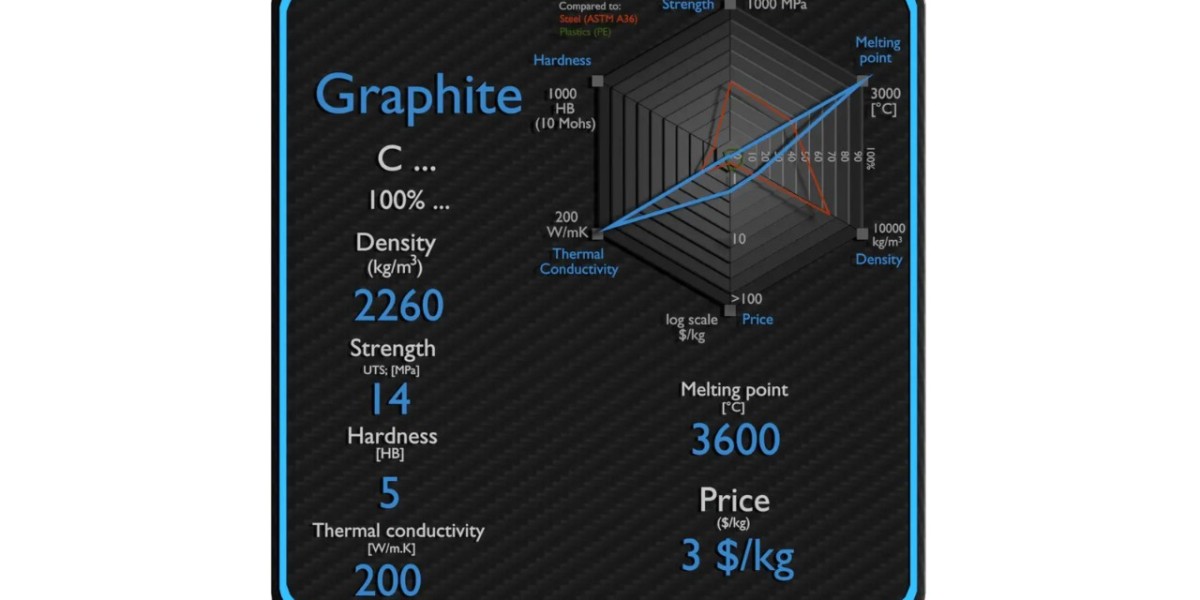
Graphite density refers to the mass of graphite per unit volume, typically expressed in grams per cubic centimeter. The theoretical density of pure crystalline graphite is approximately 2.26 g/cm³. This value represents graphite with a perfectly ordered crystal structure and no porosity.
In industrial applications, most graphite products have lower bulk density due to microscopic pores formed during manufacturing. Commercial graphite density generally ranges from 1.50 to 1.95 g/cm³. High density graphite grades usually fall between 1.75 and 1.95 g/cm³ and are engineered for enhanced mechanical strength and reduced porosity.
Density reflects how compact the graphite structure is. A higher density indicates fewer internal voids, which usually translates into improved structural integrity and conductivity.
True Density and Bulk Density
When discussing graphite density, it is important to distinguish between true density and bulk density.
True density refers to the density of the solid graphite material excluding pores and void spaces. It is very close to the theoretical density of graphite and represents the intrinsic carbon structure.
Bulk density includes the total volume of the graphite material, including open pores. Most industrial specifications refer to bulk density because it represents the actual performance characteristics of the material in real-world conditions.
Higher bulk density generally means lower porosity, improved compressive strength, and better electrical and thermal conductivity. Lower bulk density may provide advantages in lightweight applications or improved resistance to rapid thermal expansion.
Understanding the difference between these two measurements ensures accurate evaluation of graphite material properties.
How Graphite Density Is Measured
Accurate measurement of graphite density is essential for quality control and application reliability. Several standardized methods are commonly used in laboratories and manufacturing facilities.
The Archimedes principle is one of the most widely used techniques. In this method, a graphite sample is weighed in air and then submerged in a liquid. The displaced liquid volume is used to calculate the sample’s volume, and density is determined by dividing mass by volume.
Geometric measurement is another practical method for regularly shaped graphite components. Technicians measure dimensions such as length, width, and height, calculate volume, and divide the mass by the calculated volume to determine density.
Helium pycnometry is used for highly accurate true density measurement. This technique measures the volume of solid material excluding open pores by analyzing gas displacement, providing precise data for research and advanced applications.
Routine density testing ensures consistency across production batches and verifies compliance with technical specifications.
Factors That Influence Graphite Density
Several key factors influence graphite density during production and processing.
Raw material quality plays a significant role. High purity petroleum coke or coal tar pitch produces better crystalline alignment after graphitization, resulting in improved density and conductivity.
Manufacturing method strongly affects density. Isostatic pressing applies uniform pressure in all directions, creating consistent and higher density graphite. Extrusion may produce slight directional variations in density, while vibration molding is commonly used for large graphite blocks.
Graphitization temperature impacts crystal structure and compactness. Higher processing temperatures improve structural ordering, increasing both density and electrical conductivity.
Porosity control is critical. Increased porosity lowers bulk density and may reduce mechanical strength. Impregnation processes can fill microscopic pores with resin or pitch, enhancing density and structural stability.
These factors collectively determine the final graphite density and overall performance characteristics.
Relationship Between Density and Material Properties
Graphite density has a direct impact on several mechanical and thermal properties.
Higher density graphite typically provides greater compressive strength and flexural strength. This makes it suitable for load-bearing furnace components and structural applications exposed to mechanical stress.
Electrical conductivity improves with increased density because fewer pores interrupt electron pathways. High density graphite is therefore preferred for electric arc furnace electrodes and electrochemical processes.
Thermal conductivity also benefits from higher density. Dense graphite transfers heat efficiently, making it ideal for crucibles, heat exchangers, and thermal management systems.
Oxidation resistance may improve with reduced porosity, as limited oxygen penetration slows material degradation at elevated temperatures.
Lower density graphite can sometimes offer enhanced thermal shock resistance because its slightly higher porosity allows it to absorb stress during rapid temperature changes without cracking.
Selecting the appropriate graphite density requires balancing strength, conductivity, thermal stability, and operational conditions.
Types of Graphite and Their Density Characteristics
Graphite is available in several forms, each with distinct density characteristics and applications.
Natural graphite is mined from mineral deposits and may have a true density close to the theoretical value. It is often used in lubricants, battery materials, and refractory blends.
Synthetic graphite is produced through high-temperature processing of carbon precursors. It offers controlled density, high purity, and consistent performance for industrial applications.
Isostatic graphite features uniform density and fine grain structure. It is commonly used in semiconductor manufacturing and high-temperature vacuum furnaces.
Extruded graphite provides reliable mechanical strength and moderate density, making it suitable for rods, plates, and structural components.
Vibration-molded graphite is often used for large-scale industrial parts requiring dimensional stability and strength.
Each type is selected based on density requirements and specific performance needs.
Industrial Uses of Graphite Based on Density
Graphite density plays a crucial role across multiple industries.
In steel production, high density graphite electrodes are essential for electric arc furnaces due to their strength and conductivity at extreme temperatures.
In lithium-ion batteries, graphite anodes require optimized density to enhance volumetric energy density and maintain structural integrity during repeated charging cycles.
In refractory applications, dense graphite crucibles resist molten metal penetration and thermal stress, extending service life in casting operations.
In aerospace and defense industries, graphite components must withstand high heat and mechanical loads. High density graphite ensures dimensional stability and reliability.
In chemical processing plants, graphite heat exchangers and corrosion-resistant equipment rely on dense material to maintain performance in aggressive environments.
Across all these sectors, understanding graphite density ensures safe operation and efficient production.
Advantages of High Density Graphite
High density graphite offers improved mechanical strength, enhanced electrical conductivity, and better thermal performance. Reduced porosity increases oxidation resistance and extends operational life. Dimensional stability supports precise machining and reliable performance in critical systems.
These advantages make high density graphite a preferred material in demanding industrial applications where consistency and durability are essential.
FAQs
What is the standard density of graphite?
The theoretical density of graphite is approximately 2.26 g/cm³, while industrial graphite typically ranges from 1.50 to 1.95 g/cm³ depending on grade and manufacturing method.
Why is graphite density important?
Graphite density affects mechanical strength, electrical conductivity, thermal conductivity, and resistance to high temperature environments.
How does porosity affect graphite density?
Higher porosity lowers bulk density and may reduce strength, while lower porosity increases density and improves structural integrity.
Which industries require high density graphite?
Steel manufacturing, battery production, aerospace, semiconductor processing, and chemical industries commonly use high density graphite components.
How can graphite density be tested?
Graphite density is measured using the Archimedes principle, geometric volume calculations, and helium pycnometry for precise true density analysis.
Conclusion
Graphite density is a critical property that determines strength, conductivity, thermal stability, and overall durability. While the theoretical density of graphite is approximately 2.26 g/cm³, industrial grades typically range between 1.50 and 1.95 g/cm³ depending on manufacturing methods and porosity levels.
Understanding how graphite density is measured and how it influences material properties allows engineers and manufacturers to select the most suitable graphite grade for their applications. From electric arc furnace electrodes and battery anodes to refractory crucibles and aerospace components, density plays a central role in ensuring reliable and efficient performance.
By focusing on density specifications alongside purity and structural quality, industries can achieve improved productivity, longer service life, and consistent results in high-performance environments.