
But here's what rarely gets said out loud — a significant number of blast damper installations across industrial facilities are technically compliant and functionally questionable at the same time.
That gap between “passes the audit” and “actually works when it needs to” is where the real risk lives.
And almost nobody talks about it.
The Mistake Hiding in Plain Sight
It's not negligence. It's not incompetence. It's something more subtle — and honestly, more dangerous because of that.
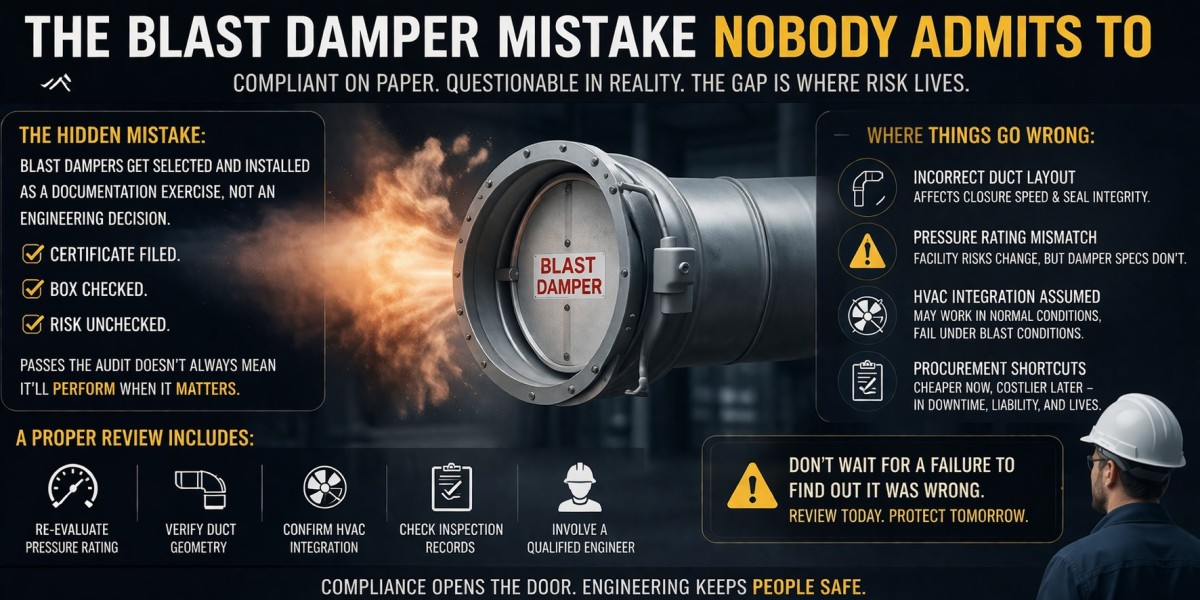
The mistake is this: blast dampers get selected and installed as a documentation exercise rather than an engineering one.
The project needs a blast-rated component to satisfy a specification. A product gets sourced. A certificate gets filed. The box gets checked.
What doesn't always happen? A genuine engineering review of whether that specific damper, in that specific location, under that facility's actual risk conditions, will perform the way everyone assumes it will.
What most engineers don't realize: Certification on paper and performance in the field are two different conversations — and industrial safety systems deserve both.
Where Things Actually Go Wrong
A blast damper's response depends heavily on how it's integrated into the surrounding ductwork. Bends too close to the valve, incorrect duct sizing, or poor airflow conditions can all affect closure speed and seal integrity.
This detail gets skipped more often than it should — usually because it adds engineering hours nobody budgeted for.
The pressure rating doesn't match the real threat
Facilities change. New processes get added. Storage configurations shift. But the blast valve spec from the original build? It rarely gets revisited.
Here's where things go wrong: the damper is rated for an older, lower risk profile while the actual facility has quietly become a higher-risk environment.
The HVAC safety interaction is assumed, not verified
In combined HVAC and blast protection systems , the damper has to function correctly under both normal airflow conditions and emergency overpressure events. These are very different operating states.
Hidden risk: A damper that works fine under normal HVAC operation may respond too slowly — or partially — under actual blast conditions if the integration was never stress-tested.
The Procurement Shortcut That Costs Later
Most blast damper purchases follow the same pattern: the spec goes to procurement, three quotes come in, and the decision lands somewhere between budget and delivery time.
Engineering input? Often minimal at that stage.
Cost insight: The price difference between a correctly specified blast damper and a cheaper alternative might be a few thousand dollars upfront. The cost of a failure — in downtime, liability, retrofitting, and investigation — runs several orders of magnitude higher.
The biggest issue is that nobody finds out the damper was wrong until something happens. And by then, the facility, the team, and the paperwork are all under scrutiny nobody wanted.
For facilities that want to get this right from the start, review in blast valve system with proper engineering support makes a measurable difference in long-term safety outcomes.
Industries Where This Mistake Is Most Costly
Blast dampers are critical across a range of high-risk environments:
Oil & gas facilities — where overpressure events can cascade rapidly
Chemical and petrochemical plants — handling volatile compounds daily
Defense and government bunkers — where failure is simply not an option
Pharmaceutical plants — particularly those working with flammable solvents
Tunnels and underground infrastructure — where pressure has nowhere to go
In every one of these environments, a damper that looks right on paper but underperforms in reality isn't just a compliance issue — it's a safety gap with real consequences.
Review your facility's safety setup today, especially if your blast protection specification hasn't been revisited since the original installation.
What a Proper Blast Damper Review Actually Looks Like
It's not complicated. But it does require intention.
Re-evaluate the pressure rating against your current operational risk
Verify duct geometry and placement around the damper
Confirm HVAC and blast protection systems are integrated correctly
Check that inspection and maintenance records are current
Involve a qualified engineer — not just a procurement team
Most facilities miss this part: The review doesn't need to be a full system overhaul. Often it's a targeted assessment that takes days, not months — and closes gaps that have been sitting open for years.
Also explore explosion protection strategies in industrial plants to understand how blast dampers connect to your wider safety infrastructure.
FAQs
What is a blast damper used for?
A blast damper seals ventilation and HVAC ducts during an explosion event, preventing pressure waves from traveling through ductwork and causing further structural damage or casualties.
How is a blast valve different from a blast damper?
A blast damper is the broader category of overpressure control device. A blast valve refers specifically to the rapid-closure mechanism that activates under sudden pressure surge conditions.
Where are blast dampers required?
They are required in high-risk industrial environments including oil refineries, chemical plants, defense installations, pharmaceutical facilities, and underground infrastructure where explosion risk is operationally credible.
Are blast dampers mandatory in industrial safety systems?
In many jurisdictions and facility types, blast-rated ventilation protection is required under safety codes and standards. Even where not legally mandated, it is considered engineering best practice in any credible explosion risk environment.
How often should blast dampers be inspected?
At minimum annually, with more frequent checks in harsh environments. Mechanical components — springs, seals, closure mechanisms — degrade over time and require hands-on verification, not just visual inspection.
Final Thought
The blast damper mistake nobody admits to isn't dramatic. There's no single moment of failure to point to.
It's a slow accumulation of assumptions — that the spec is still valid, that the install was done right, that someone else is checking it.