
A cement plant in Satna once ran the wrong bearing series in a kiln support roller for six months before a vibration analyst caught it during a routine audit. Nobody had flagged it. The equipment hadn't failed yet — it was just running hotter and louder than it should, quietly eating into bearing life every shift. A cylindrical roller bearing built for the wrong application doesn't always announce itself with a breakdown. Sometimes it just costs you months of shortened service life before anyone notices.
That's the part most procurement conversations skip. Everyone asks what a bearing can do. Almost nobody asks what it's actually built to handle, and where that capability runs out.
What Defines This Bearing Type on a Spec Sheet
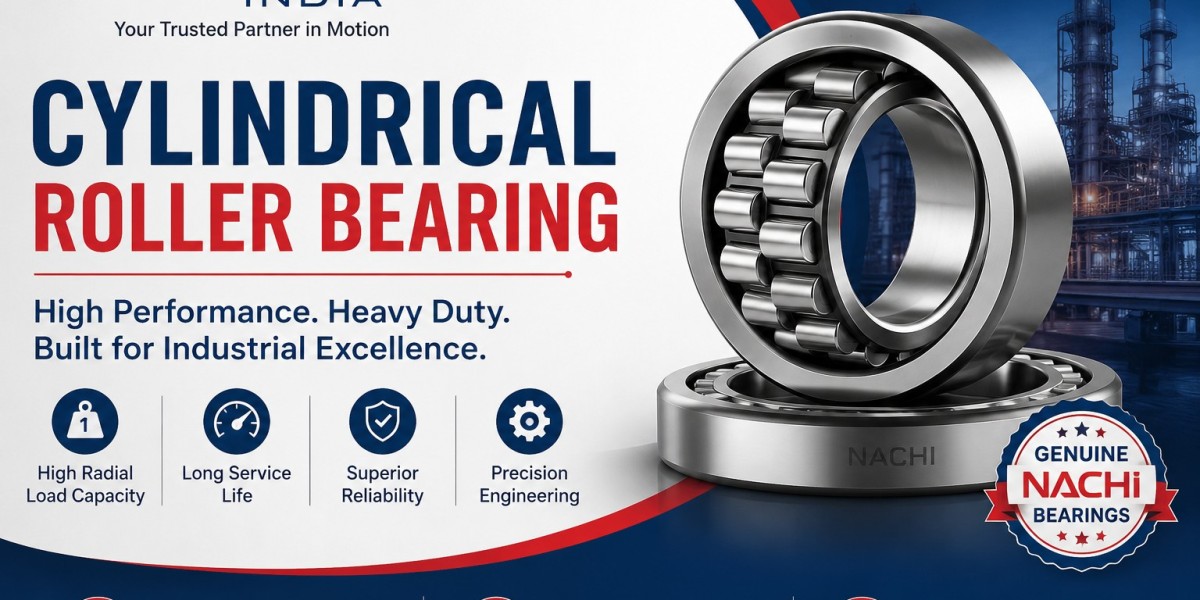
A cylindrical roller bearing uses line contact between roller and raceway instead of the point contact you get in a ball bearing. That single design difference is why it handles heavier radial loads at a given size — and why axial capacity is limited or absent depending on the series.
Core Design Variants
NU/N series — permit axial displacement, ideal for the non-locating position in a shaft assembly where thermal growth needs room.
NJ/NUP series — provide axial location through a flange arrangement, used where the shaft needs positioning as well as radial support.
Full complement series — remove the cage entirely to pack in more rollers, raising load capacity at the cost of a lower maximum speed rating.
The Detail Buyers Consistently Miss
Radial internal clearance changes with operating temperature, not just with the clearance class printed on the box. A C3 clearance bearing running in a 70°C environment behaves differently than the same part at 25°C, and very few purchase orders account for that shift before the equipment is even commissioned.
Five Criteria That Separate a Real Supplier From a Reseller
Do they ask about your application's speed and load profile before quoting a part number? A bad answer jumps straight to price with no technical qualification at all.
Can they provide batch traceability documentation without being asked twice? A bad answer offers to "arrange it later" once the order is placed.
Do they hold genuine Nachi Cylindrical Roller Bearing stock in India, or import on demand after your order? A bad answer is a vague reference to "our global network" with no local warehouse specified.
What's their stated policy on premature failure claims? A bad answer treats every failure differently instead of pointing to a written warranty term.
Will they tell you if a cheaper series genuinely meets your load requirement? A bad answer always defaults to the highest-margin recommendation regardless of fit. That's a sales instinct, not technical advice.
Benefits That Translate Directly to Plant Economics
Higher radial load capacity per unit size — this lets equipment designers use a smaller bearing footprint without sacrificing load rating, which matters in space-constrained gearbox housings.
Reduced friction under heavy load — line contact distributes stress more evenly than point contact, which cuts heat generation and extends lubricant intervals.
Lower unplanned downtime risk — a correctly matched bearing in a mining crusher or rolling mill stand reduces the odds of the mid-shift failure that halts an entire production line.
Easier disassembly in separable designs — NU and N series allow the inner and outer rings to be mounted separately, which simplifies maintenance in large industrial gearboxes.
Better heat dissipation in high-speed applications — this protects seals and adjacent components from thermal degradation, which often costs more to replace than the bearing itself.
Predictable replacement cycles — when service life matches the rated calculation, spare parts budgeting stops being guesswork and starts being a forecast.
Where This Bearing Type Actually Gets Used Across India
Mining operations in Jharkhand run cylindrical roller bearings in crusher and conveyor drive systems where radial shock load is constant. Steel rolling mills across Chhattisgarh depend on double-row and full-complement variants in roll neck applications where rigidity under extreme load is non-negotiable. Paper mills in Uttar Pradesh use them in dryer section rolls, and cement plants from Rajasthan to Andhra Pradesh rely on them in kiln support and raw mill applications.
Supply location changes how fast any of these plants can actually respond to a failure. A Nachi Cylindrical Roller Bearing Supplier & Distributor in India holding regional stock turns a breakdown into a same-week fix. A supplier importing on a case-by-case basis turns it into a three-week wait, and that gap costs more in lost production than most bearings cost outright.
About Us
We've supplied Nachi Cylindrical Roller Bearing inventory to Indian manufacturers since 2013, and one thing that's stayed consistent across those years is how often the same failure pattern repeats across unrelated industries — a bearing running fine on paper, failing early in practice, because nobody checked the actual operating temperature against the clearance class.
We had a mining sector client in 2022 whose crusher bearings kept failing at roughly 60% of rated life. We pulled the failed units, checked shaft fit tolerances, and found the housing bore had been machined 0.02mm outside spec — enough to change the effective clearance under load. We told them what we found instead of quietly replacing the part under warranty and moving on. That's what genuine field experience looks like, not a marketing claim.
Our team has walked plant floors during actual failures, not just reviewed drawings in an office. That's the difference between recommending a part number and diagnosing an actual problem.
Talk to Us Before Your Next Order Goes Out
Send IBH India your bearing's current part number along with your equipment's RPM and radial load, and we'll respond within 24 hours confirming whether it's the right fit or flagging what isn't. Minimum order quantity is one unit for standard sizes, so a single urgent replacement doesn't get forced into a bulk order. Mention your industry and application — mining, steel, cement, or paper — so we can match the right series faster.
Conclusion
A cylindrical roller bearing is a design built for one purpose heavy radial load space efficiently. And it best fulfills that purpose only when the specific series, clearance and cage material being used matches the original application exactly. India‘s mines, steel, cement and paper plants run on this part more than you think, and those who think of choosing them as a technical decision, instead of a put-in-when-empty re-order item, avoid the repeat failures. Your next prevention call begins with the specs sheet you might read this time.
Frequently Asked Questions
What industrial applications rely most heavily on cylindrical roller bearings?
Mining crushers and conveyors, steel rolling mill roll necks, paper mill dryer rolls, and cement kiln support rollers all depend on this bearing type for heavy radial load capacity under continuous operation.
How is a Nachi Cylindrical Roller Bearing different from a generic unbranded equivalent?
Beyond material and heat-treatment consistency, genuine Nachi bearings carry traceable batch documentation and tighter manufacturing tolerances — differences that matter most under sustained heavy load, less so in light-duty applications.
Can Nachi Cylindrical Roller Bearing Suppliers in India match bearings for older, discontinued machinery?
Usually yes, through cross-reference to a current equivalent series, though genuinely obsolete part numbers from older imported equipment sometimes need a physical sample to confirm an exact match.
What's the typical service life difference between a correctly specified bearing and a mismatched one?
A well-matched bearing often reaches its full rated life of tens of thousands of hours, while a mismatched clearance class or cage material can cut that down by 40% or more — the exact figure depends heavily on load and temperature conditions.
Do Nachi Cylindrical Roller Bearing Authorized Distributors in India offer technical support for bearing selection?
Yes, though the depth of that support varies significantly between distributors — some only confirm part numbers, while others actually review your load and speed data before recommending anything.