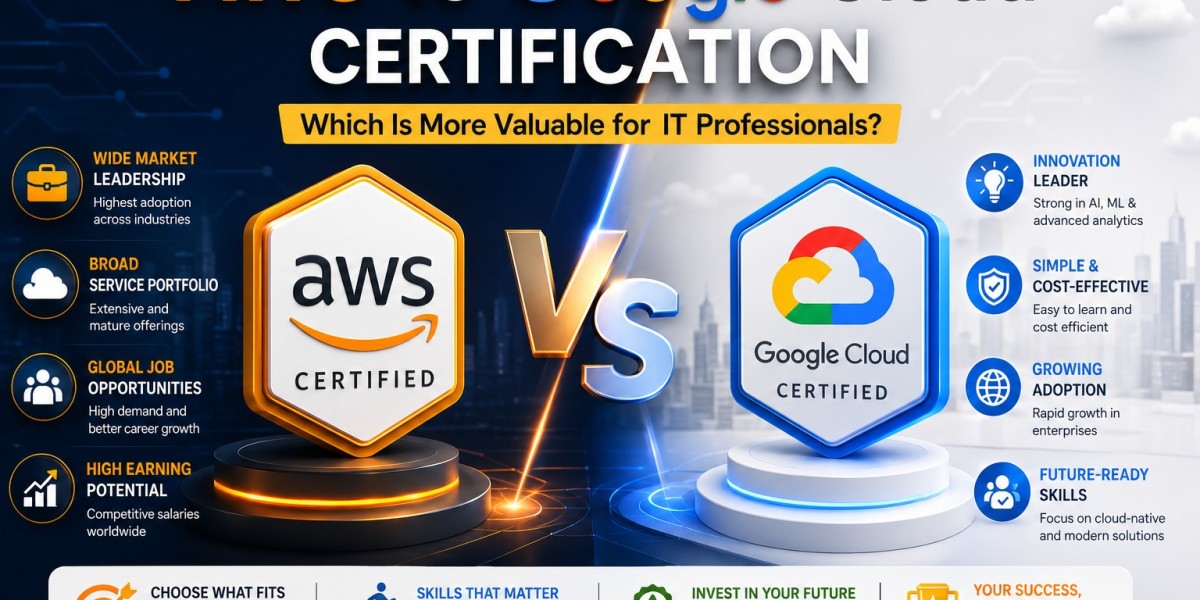

AWS and Google Cloud certifications can both strengthen a cloud computing career, but their value depends heavily on the technology environment, job role, and specialization an IT professional wants to pursue. AWS offers a broad certification ecosystem covering cloud architecture, development, operations, security, data, and AI, while Google Cloud provides focused credentials for engineering, architecture, data, machine learning, security, and DevOps roles.
For most professionals, the better choice is not simply the certification from the larger cloud brand. The more valuable certification is the one that matches the cloud platform used by target employers and develops skills relevant to the job you want.
AWS vs Google Cloud Certification at a Glance
Both certification ecosystems support beginners and experienced cloud professionals, but their structures differ.
Factor | AWS Certification | Google Cloud Certification |
Main Platform | Amazon Web Services | Google Cloud |
Entry-Level Path | Foundational | Foundational |
Technical Progression | Associate, Professional, Specialty | Associate, Professional |
Architecture Path | Solutions Architect | Cloud Architect |
Engineering Path | Developer, CloudOps, DevOps | Cloud Engineer, Cloud Developer, DevOps Engineer |
Security Path | Security specialty | Cloud Security Engineer |
Data and AI | Data and AI-focused credentials | Data Engineer, ML Engineer and AI-focused credentials |
Standard Validity | 3 years | 2–3 years depending on level |
AWS certifications are generally valid for three years. Google Cloud currently gives foundational and associate certifications a three-year validity period, while professional certifications are generally valid for two years.
What Makes AWS Certification Valuable?
AWS provides one of the broadest cloud certification structures. Its official certification documentation organizes credentials into foundational, associate, professional, and specialty categories.
This allows candidates to start with cloud fundamentals and gradually move into deeper technical roles.
Popular AWS Certification Directions
AWS certification paths can support professionals interested in:
Cloud architecture
Application development
Cloud operations
DevOps
Cloud security
Data engineering
Machine learning
AI-related cloud services
AWS Certified Solutions Architect – Associate, for example, validates the ability to design solutions using AWS services and is currently valid for three years.
AWS Certified DevOps Engineer – Professional targets advanced experience in provisioning, operating, and managing distributed application systems while emphasizing automation and secure delivery.
Who Should Choose AWS?
AWS certification may provide greater practical value if you:
Already work in an AWS environment
Want cloud architecture or engineering roles
Need several certification levels for career progression
Work with organizations heavily using AWS services
Want options across development, operations, security, data, and AI
AWS also provides AWS Skill Builder, official exam preparation resources, question sets, labs, and practice exams to support certification preparation.
What Makes Google Cloud Certification Valuable?
Google Cloud certifications focus strongly on technical job functions and platform-specific expertise.
Google currently lists foundational certifications such as Cloud Digital Leader and Generative AI Leader, an Associate Cloud Engineer credential, and professional certifications across architecture, development, data, security, DevOps, networking, databases, and machine learning.
Strong Google Cloud Career Areas
Google Cloud certification can be particularly relevant for professionals interested in:
Cloud engineering
Cloud architecture
Data engineering
Machine learning
DevOps
Cloud security
Database engineering
Google Cloud infrastructure
The Professional Cloud Architect certification evaluates abilities such as designing cloud architecture, provisioning infrastructure, designing for security and compliance, managing implementation, and optimizing business and technical processes.
The Professional Machine Learning Engineer certification also provides a specialized path for professionals working with machine learning workloads and technologies including Vertex AI.
AWS vs Google Cloud for Beginners
Beginners can start with either ecosystem.
AWS Certified Cloud Practitioner validates high-level knowledge of AWS Cloud, services, and terminology and is positioned as an entry point for people moving into cloud careers.
Google Cloud Digital Leader similarly validates broad understanding of Google Cloud concepts, services, capabilities, and business use cases without requiring technical prerequisites.
For someone who wants technical administration skills early, Google also provides the Associate Cloud Engineer certification. Google recommends at least six months of hands-on Google Cloud experience for that exam, although there are no formal prerequisites.
Beginners should therefore choose the platform they can realistically practice and expect to use professionally.
AWS vs Google Cloud for Cloud Architects
Both platforms offer strong architecture credentials.
AWS candidates can progress through Solutions Architect certifications, while Google Cloud professionals can pursue Professional Cloud Architect.
The important difference is platform-specific knowledge. An AWS architect must understand AWS services, architecture patterns, security, networking, storage, and cost considerations. A Google Cloud architect must solve similar business and technical problems using Google Cloud technologies.
Neither credential automatically makes someone a better cloud architect across every environment. Hands-on architecture experience remains essential.
AWS vs Google Cloud for Data and AI Careers
Google Cloud deserves particular attention from professionals interested in data and machine learning because its certification portfolio includes dedicated Professional Data Engineer and Professional Machine Learning Engineer credentials.
AWS also continues to develop its data, machine learning, and AI certification paths. AWS announced certification updates during 2026 involving Data Engineer, Machine Learning Engineer, and other credentials as its certification portfolio evolves.
For AI or data professionals, the best choice should therefore follow the platform used by the datasets, pipelines, models, and production systems they expect to manage.
Which Certification Is Better for Cybersecurity?
Both providers offer advanced security paths.
AWS Certified Security – Specialty validates AWS-focused cloud security knowledge and currently remains valid for three years.
Google's Professional Cloud Security Engineer certification focuses on designing and implementing secure workloads and infrastructure while applying Google security technologies and industry security practices.
Choose AWS Security when your security responsibilities center on AWS environments. Choose Google Cloud Security Engineer when your organization operates primarily on Google Cloud.
Career Advantages of AWS and Google Cloud Certifications
Cloud certifications can offer several practical benefits when supported by genuine technical experience:
Validate platform-specific cloud knowledge
Provide structured learning objectives
Strengthen cloud architecture fundamentals
Demonstrate specialization to employers
Support transitions into cloud-focused positions
Help professionals identify knowledge gaps
Provide a pathway toward advanced cloud roles
Google reported in its certification research that many learners viewed certification as beneficial to career development and skill building.
Certification should still complement projects, labs, troubleshooting, and professional experience rather than replace them.
How to Choose Between AWS and Google Cloud Certification
Use your career target to make the decision.
Review cloud technologies used by employers you want to join.
Identify whether your desired role involves architecture, engineering, security, DevOps, data, or AI.
Compare certifications for that specific role.
Build hands-on experience with the selected cloud platform.
Study the official exam guide and learning resources.
Complete practical projects before relying heavily on practice exams.
Use exam-style questions to identify weak areas.
Candidates using this website, www.certempire.com, can identify knowledge gaps through question practice and strengthen those areas with hands-on cloud labs.
Challenges of Choosing One Cloud Platform
Focusing on a single provider has some limitations.
Key considerations include:
Platform-specific skills may not transfer directly between every service.
Certification content changes as cloud services evolve.
Employers may operate multi-cloud environments.
Advanced certifications require practical experience.
Maintaining multiple credentials takes additional study time.
Once you understand one cloud platform deeply, learning another often becomes easier because many underlying concepts such as networking, identity, compute, storage, containers, databases, and security remain transferable.
Which Is More Valuable in 2026?
For broad AWS-focused cloud roles and a highly structured certification ladder, AWS certification can be an excellent choice. AWS currently reports more than 1.42 million active certifications and more than 1.05 million unique AWS Certified individuals as of January 2025, illustrating the scale of its certification ecosystem.
Google Cloud certification can be especially valuable for professionals targeting organizations using Google Cloud or roles centered on data engineering, AI, machine learning, cloud architecture, security, and DevOps.
The strongest credential is ultimately the one connected to real job requirements.
Conclusion
AWS and Google Cloud certifications are both valuable for IT professionals in 2026, but they serve different career environments.
AWS offers a broad certification ladder with multiple technical directions and is a strong choice for professionals working with AWS infrastructure. Google Cloud provides highly focused certifications for cloud engineering, architecture, data, AI, security, and DevOps roles.
Instead of asking which certification is universally better, determine which platform appears most frequently in your target jobs. Then combine the certification with hands-on labs, projects, documentation, and troubleshooting experience. That combination provides considerably more career value than certification alone.
FAQs
Is AWS certification better than Google Cloud certification?
Neither is universally better. AWS certification is more valuable for AWS-based jobs, while Google Cloud certification is more relevant when employers use Google Cloud. Career goals and platform experience should guide the decision.
Which certification is better for beginners?
AWS Certified Cloud Practitioner and Google Cloud Digital Leader are both designed for foundational cloud knowledge. Beginners seeking more technical Google Cloud experience can also progress toward Associate Cloud Engineer.
Which cloud certification is best for data engineers?
Google Cloud offers a dedicated Professional Data Engineer certification. AWS also provides data-focused certification paths, so professionals should choose according to the cloud platform used in their target data roles.
How long do AWS and Google Cloud certifications remain valid?
AWS certifications generally remain valid for three years. Google Cloud foundational and associate certifications generally remain valid for three years, while professional certifications generally use a two-year validity period.
Should I learn both AWS and Google Cloud?
Learning both can be useful for professionals working in multi-cloud environments, but beginners usually benefit from developing strong practical skills in one platform before adding a second cloud ecosystem.
Read More: Microsoft AZ-802 Certification 2026: Is It Worth It?