
Europe Behind-the-Meter (BtM) BESS Market: The C&I Opportunity
Europe’s commercial and industrial sector is entering a period of rapid electricity-system change. Electrification, evolving tariffs, and pressure to control costs are encouraging companies to reconsider how electricity is consumed onsite. Behind-the-meter battery storage provides a practical tool for managing these changes. Rather than serving only as backup equipment, batteries can become active assets that reshape demand, improve solar utilization, and support more predictable energy costs.
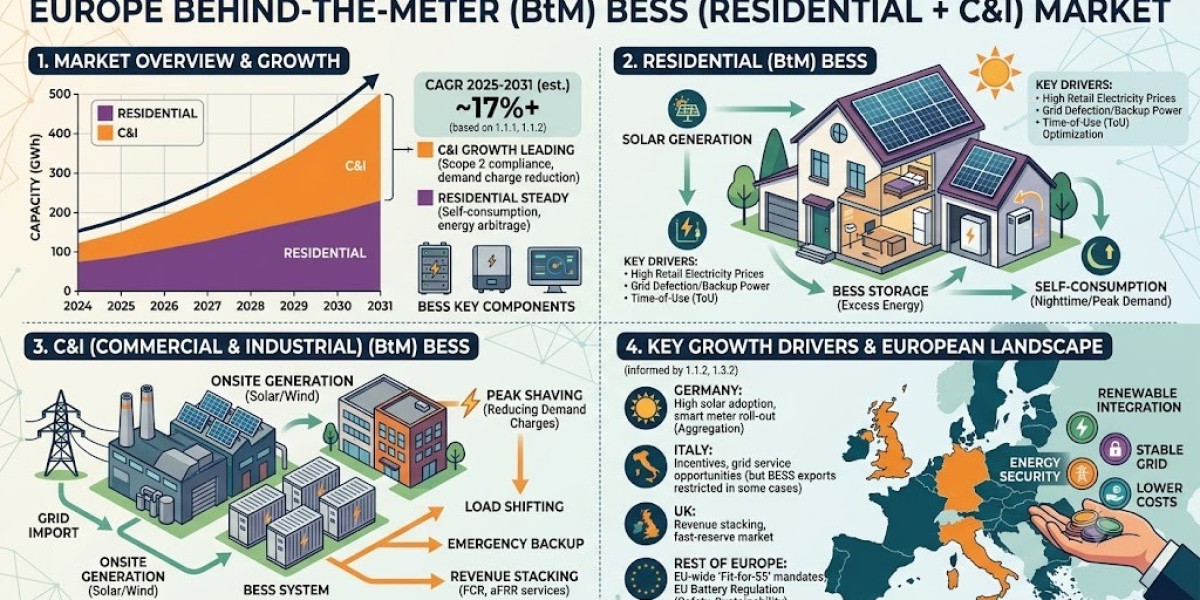
The strongest applications often begin with peak management. A facility with short periods of high demand can discharge a battery during those intervals, reducing grid draw. Where tariffs include demand charges or expensive peak windows, these savings can create an economic foundation. The opportunity is relevant for manufacturing sites, warehouses, offices, hotels, and retail properties with measurable load patterns.
Solar integration adds another layer. Commercial buildings frequently generate electricity during hours when onsite demand does not fully absorb production. A battery can store excess generation and release it later, increasing self-consumption and reducing dependence on grid electricity. This becomes increasingly valuable when export compensation is less attractive than the avoided cost of purchasing electricity.
However, project economics are not uniform across Europe. Retail tariffs, network charges, export rules, and local grid conditions differ by country and sometimes by distribution area. A battery that produces attractive savings at one location may deliver weaker results elsewhere. Developers need site-level assessments combining customer load data, tariffs, and distribution network constraints.
The Europe Behind-the-Meter (BtM) BESS Market Analysis perspective emphasizes that value is created by the complete operating model, not by battery capacity alone. Installation schedules, metering configuration, telemetry, control software, and aggregator onboarding can determine whether a technically completed system actually produces expected revenues. Projects should therefore treat commissioning as a financial milestone rather than merely an engineering task.
Electric vehicle charging is expanding the opportunity. Fleets and workplace charging can create substantial new electricity demand, often concentrated in particular periods. Storage can buffer charging loads, reduce demand peaks, and help businesses avoid drawing excessive power from the grid. Combining solar, charging, and storage can create an integrated energy-management platform.
Flexibility markets may provide additional revenue, but they require careful underwriting. Aggregated batteries can potentially respond to grid needs through coordinated dispatch, yet participation depends on market eligibility, settlement rules, measurement standards, and control permissions. Flexibility income is more credible when its technical and regulatory pathway has been demonstrated.
Technology decisions are becoming more sophisticated. Buyers are considering safety, degradation, warranty limitations, cybersecurity, interoperability, and software capability alongside battery chemistry. High utilization can improve value but may accelerate degradation or create warranty concerns if operating strategies are poorly aligned with equipment conditions.
For suppliers, the opportunity is shifting from selling storage boxes to delivering measurable energy outcomes. Companies integrating hardware, energy-management systems, analytics, and optimization may gain an advantage over equipment-focused providers. Service-based and shared-savings models could also reduce upfront barriers for businesses that prefer operating expenditure structures.
Over the next several years, commercial storage adoption is likely to favor sites where bill savings are visible, load profiles are predictable, and grid rules are understandable. The most attractive projects will combine multiple benefits without depending on speculative assumptions. In this environment, disciplined site selection and operational execution can matter as much as falling equipment costs.
Europe’s behind-the-meter opportunity is therefore becoming a strategic energy-management market. For C&I customers, batteries can reduce peaks, increase renewable self-consumption, support electric mobility, and potentially unlock flexibility revenue. The winning approach will be to build projects around proven customer economics first, then layer additional services where regulation and infrastructure make those revenues dependable.