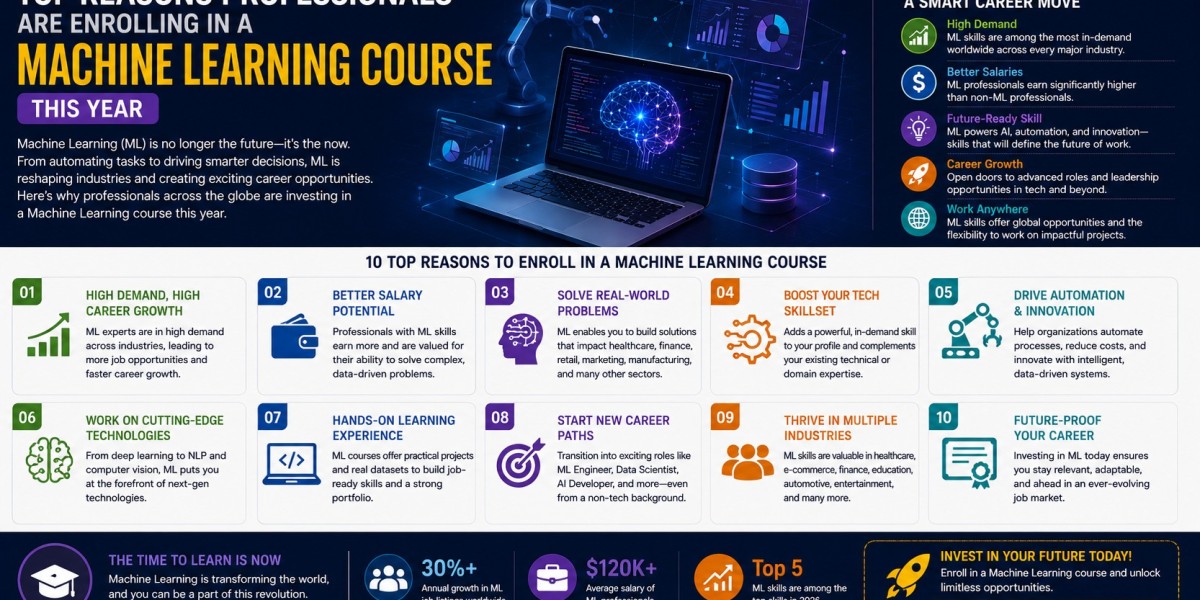

Machine learning has moved from being a specialized technology used mainly by data scientists to becoming an important business skill across industries. Companies are using machine learning to automate repetitive decisions, understand customer behavior, improve forecasting, detect risks, and create smarter digital products. As a result, professionals from IT, business analytics, software development, finance, marketing, and operations are increasingly looking for practical ways to build machine learning expertise.
This growing interest is one reason a machine learning course has become an attractive career investment. Professionals are not simply learning algorithms for academic knowledge. They want to understand how machine learning works in real business environments and how modern tools can make model development, deployment, and management more efficient.
Technologies such as DataRobot, AutoML, machine learning platforms, and data science automation are also changing how professionals approach machine learning projects. Instead of spending all their time writing code from scratch, learners can explore automated workflows while developing the technical understanding required to evaluate and improve machine learning solutions. Here are the top reasons professionals are enrolling in machine learning training this year.
1. Machine Learning Skills Are Becoming Valuable Across Industries
Machine learning is no longer limited to technology companies. Organizations in banking, healthcare, retail, manufacturing, telecommunications, logistics, insurance, and other sectors are using data-driven technologies to solve practical problems. For professionals, this creates opportunities to apply machine learning knowledge within their existing fields.
A finance professional, for example, may encounter machine learning through fraud detection and risk analysis. A marketing professional may use predictive models for customer segmentation. An operations specialist may explore forecasting and optimization. Meanwhile, software professionals may work directly on machine learning applications and model deployment.
A structured machine learning course can help professionals understand these applications while building skills that can be transferred between industries.
2. AutoML Is Making Machine Learning More Accessible
One of the biggest developments in modern machine learning is AutoML, or automated machine learning. Traditional machine learning projects can involve multiple stages, including data preparation, feature engineering, algorithm selection, model training, evaluation, and deployment. AutoML tools can automate or simplify several of these activities.
This does not mean professionals no longer need machine learning knowledge. In fact, understanding the fundamentals becomes even more important because professionals need to know whether an automated model is appropriate, how its performance should be evaluated, and what the results actually mean. Learning AutoML through practical machine learning training can therefore help professionals combine automation with informed decision-making.
3. DataRobot Is Increasingly Relevant to Machine Learning Professionals
DataRobot is a well-known name in the automated machine learning ecosystem. Its technology is designed to help organizations develop, evaluate, deploy, and manage machine learning solutions. For professionals, learning how to work with DataRobot machine learning can provide exposure to an enterprise-oriented approach to machine learning workflows.
A professional who understands both machine learning fundamentals and platforms such as DataRobot can potentially communicate more effectively with data scientists, developers, business teams, and decision-makers. This is particularly useful for professionals who want to move beyond theoretical knowledge and understand how machine learning can be incorporated into real organizational processes.
4. Machine Learning Platforms Can Reduce Development Complexity
Building machine learning solutions manually can require significant technical knowledge and development time. Modern machine learning platforms help organize many of the activities involved in creating and managing machine learning models. Professionals can learn how platforms support areas such as:
Data preparation
Model experimentation
Algorithm comparison
Performance evaluation
Model management
Deployment workflows
Monitoring
Collaboration
Understanding these workflows can give learners a broader perspective than simply studying individual algorithms. A good machine learning course should therefore introduce learners to both the concepts behind machine learning and the platforms that professionals use to put those concepts into practice.
5. Data Science Automation Is Changing Professional Workflows
Data science traditionally involves many repetitive activities. Preparing datasets, testing different approaches, comparing models, and organizing experiments can consume considerable time. Data science automation aims to reduce unnecessary manual work so professionals can focus more attention on business problems, interpretation, and decision-making.
This is another reason professionals are interested in tools such as DataRobot and AutoML. Automation can accelerate parts of the workflow while still requiring skilled professionals to define objectives, validate results, interpret outcomes, and make appropriate business decisions. Learning how automation fits into the broader data science lifecycle can make professionals more comfortable working with modern analytics teams.
6. Professionals Want Practical Rather Than Purely Theoretical Skills
There is a major difference between knowing the definition of machine learning and knowing how a machine learning project works from beginning to end. Professionals increasingly want training that connects theory with practical applications. They want to understand what happens after a dataset is collected, how models are evaluated, and how a successful model eventually becomes part of a business process.
This is where practical machine learning training can provide significant value. A well-designed course can introduce concepts through realistic scenarios and platform-based exercises, helping learners understand how machine learning is used beyond textbooks and academic examples.
7. Model Deployment Is an Essential Machine Learning Skill
Developing an accurate model is only part of a machine learning project. Organizations also need to put useful models into operational environments. This process is known as model deployment. Professionals studying machine learning increasingly recognize that a model has limited business value if it never reaches the people or systems that need its predictions.
Learning about deployment can help professionals understand how models transition from experimentation to practical use. It can also introduce important concepts such as model management, performance monitoring, versioning, and ongoing improvement. For anyone planning a career involving machine learning operations, analytics, or data science, understanding deployment can be an important advantage.
8. DataRobot API Knowledge Can Expand Technical Capabilities
Professionals who want to work more deeply with DataRobot may also explore the DataRobot API. APIs can allow applications and development workflows to interact programmatically with machine learning capabilities. Instead of relying exclusively on a platform's graphical interface, technically oriented professionals can explore ways to integrate machine learning functionality into broader applications and workflows.
Learning about the DataRobot API can therefore be particularly valuable for software developers, data professionals, automation specialists, and technical consultants. It also demonstrates an important career principle: modern machine learning is increasingly connected with software engineering and application development.
9. Machine Learning Can Strengthen Career Mobility
Professionals are also enrolling in machine learning courses because they want greater career flexibility. Machine learning knowledge can complement existing skills rather than requiring professionals to completely change their career direction. For example:
A software developer can add machine learning capabilities to applications.
A data analyst can progress toward predictive analytics.
A business analyst can better understand AI-driven decision-making.
An IT professional can move toward data and AI projects.
A project manager can communicate more effectively with technical teams.
A data scientist can strengthen platform and automation expertise.
This makes machine learning training relevant to professionals at different stages of their careers.
10. DataRobot Training Can Provide Platform-Specific Knowledge
General machine learning knowledge is valuable, but platform-specific skills can help professionals understand how machine learning technologies are implemented in practical environments. A DataRobot training course can introduce learners to the platform's approach to automated machine learning and help them understand how different components fit into a broader workflow.
For learners interested in enterprise AI, this type of training can be especially useful because it connects machine learning concepts with a recognizable technology platform. The goal should not be to rely entirely on automation. Instead, professionals should develop the ability to combine machine learning fundamentals, platform knowledge, critical thinking, and business understanding.
11. AI Adoption Is Increasing the Need for Data-Literate Professionals
Artificial intelligence is becoming a larger part of business strategy. As organizations explore AI-powered applications, they need professionals who can understand data, models, predictions, and technology-related decisions. This does not mean every professional needs to become a specialist machine learning engineer.
However, understanding the basic principles of machine learning can help professionals participate more confidently in AI-related projects. A machine learning course can provide a structured path for developing this understanding, particularly for people who want to learn how machine learning connects with business applications.
12. A Structured Course Can Accelerate Learning
Self-learning is possible, but navigating machine learning independently can be challenging. There are countless algorithms, programming frameworks, platforms, tutorials, and technical concepts to explore. A structured course can organize these topics into a logical learning journey.
Instead of randomly studying individual concepts, learners can progress from foundational ideas toward practical workflows. Platform-focused training can also help them understand how theoretical concepts translate into professional tools. For busy professionals, this structure can make the learning process more focused and manageable.
What Can You Learn in a DataRobot Machine Learning Course?
A specialized DataRobot machine learning course can be useful for professionals who want to explore automated machine learning and practical AI workflows. Depending on the course curriculum, learners may explore concepts related to machine learning fundamentals, automated model development, model evaluation, deployment, platform workflows, and integration.
The most valuable outcome is not simply knowing how to click through a platform. Professionals should aim to understand why a particular model or workflow is appropriate and how machine learning results can support real business objectives. Combining theoretical understanding with hands-on platform experience can create a stronger foundation for applying machine learning professionally.
Why Choose GI Intelligence for DataRobot Machine Learning Training?
GLOBAL INDUSTRIES INTELLIGENCE LTD DataRobot Machine Learning Course can be considered by professionals looking for focused training around DataRobot and machine learning. The course is positioned around developing practical knowledge of DataRobot-based machine learning, making it relevant for learners who want to understand automated machine learning workflows and strengthen their professional AI skill set. Before enrolling, prospective learners should review the current course curriculum, learning format, prerequisites, and included topics on the official course page to ensure the program matches their career goals.
Who Should Consider a Machine Learning Course?
A machine learning course can be relevant to a wide range of professionals, including:
Data analysts
Data scientists
Software developers
IT professionals
Business analysts
AI professionals
Technology consultants
Project managers working on data projects
Professionals transitioning into data science
Managers who work with AI and analytics teams
The ideal learning path depends on a person's existing technical background and career objectives. Someone with programming experience may want to explore APIs, deployment, and advanced workflows, while a business professional may focus more heavily on machine learning applications and interpretation.
How to Get the Most Value From Machine Learning Training
Simply completing a course is not enough. Professionals should actively apply what they learn. Start by understanding the fundamentals of machine learning rather than attempting to memorize individual tools. Then explore practical datasets and experiment with different workflows.
It is also useful to understand the complete machine learning lifecycle from data preparation and model development to evaluation and model deployment. Finally, learn to connect technical results with business outcomes. A model's accuracy is important, but professionals also need to consider whether the model solves the right problem, produces useful predictions, and can be maintained effectively.
The Future of Machine Learning Skills
Machine learning is likely to remain an important component of the broader AI and data ecosystem. As platforms become more automated, professionals will increasingly need a combination of technical understanding and business judgment.
Tools such as DataRobot and AutoML can automate significant portions of machine learning workflows, but human expertise remains essential for defining problems, interpreting results, managing risks, and making strategic decisions.
This means the future professional is not necessarily someone who performs every machine learning task manually. Instead, it may be someone who understands how to use automation effectively while knowing when to question, validate, or refine automated outcomes.
Conclusion
Professionals are enrolling in a machine learning course this year because machine learning skills are becoming increasingly relevant across technology and business functions. From AutoML and DataRobot machine learning to data science automation, machine learning platforms, APIs, and model deployment, modern training can help professionals understand how machine learning moves from an idea to a practical business solution.
A focused DataRobot training course can be particularly valuable for learners who want to explore automated machine learning through a practical platform. Whether the goal is career advancement, technical upskilling, or a transition toward AI and data science, developing machine learning expertise can provide a strong foundation for participating in the increasingly data-driven workplace.