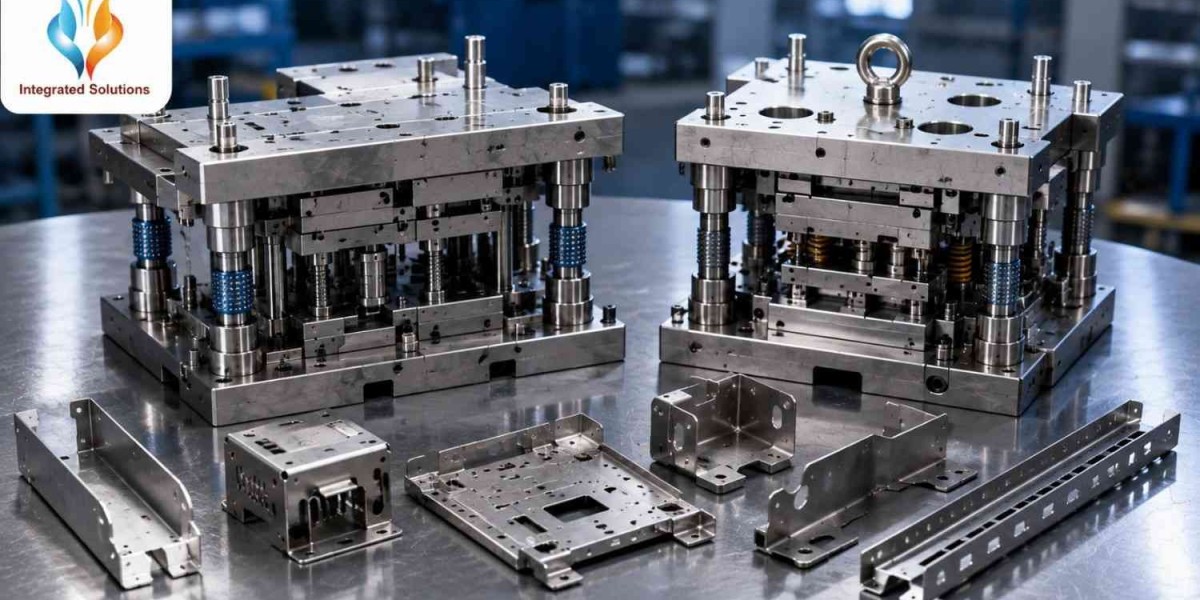

Tooling Problems Rarely Stay Inside the Tool Room
And then inspection finds a shifted hole, an opening bend, or a bracket that no longer fits at production volume. A Sheet Metal Tool controls cutting, piercing, bending and forming, so weak design becomes a production problem fast. Integrated Solutions states that its sheet-metal tool design service has operated since 2004; ISO 2768 defines four general tolerance classes. “Normal tolerance” is not a serious purchasing specification.
Most buyers compare tool prices before comparing design assumptions.
The Sheet Metal Tool Details That Decide Repeatability
Custom sheet metal tool design starts with geometry, material, thickness, bend radius, feature positions, volume and press data. Integrated Solutions publishes a typical sheet range of 0.5–6 mm, linear tolerance guidance of ±0.1–0.2 mm, high-precision bend-angle capability around ±0.5°, and D2, H13 or A2 tooling steels at a typical 55–62 HRC for core components.
Match the Die to the Production Route
Progressive dies move strip through several stations; compound dies can combine blanking and piercing; transfer dies suit larger complex parts; stage dies split forming into separate operations. Each route carries a different investment profile.
The Spec Detail Most Buyers Skip
Integrated Solutions lists a typical K-factor range of 0.30–0.45 and a hole-to-bend guideline of at least 2.5 times sheet thickness plus bend radius. Springback is harder than buyers expect because actual material behaviour still matters during forming.
Five Questions That Expose a Weak Supplier
Before approving any tooling supplier, check:
Tolerance ownership: Which dimensions are critical and how are they inspected? Bad answer: “standard tolerance.” ISO 2768 has four classes.
Tool material: Why this steel and hardness? Bad answer: “same steel for most tools.” Integrated Solutions lists 55–62 HRC for core components.
Press compatibility: What tonnage, shut height, bed size and feed method are required? Bad answer: no questions about the machine.
DFM review: Who checks bend allowance, K-factor, reliefs and feature positions? Bad answer: “we will adjust during trial.”
Revision control: How are trial changes recorded? Bad answer: the final dimensions exist only in chat messages.
A supplier who treats rework as the design process is asking the buyer to finance its engineering gaps.
Custom Tooling Protects Margin, Not Just Tolerance
Fewer disputes: Defined tolerances give both inspection teams one acceptance basis.
Lower scrap exposure: Correct bend radius and feature placement reduce distortion; the published guideline lists 1T as a typical minimum bend radius.
More predictable output: Progressive tooling can perform several operations across stations.
Lower wear risk: Tool steel and hardness can be selected around the actual load; Integrated Solutions lists D2, H13 and A2 among its tooling materials.
Easier changes: Controlled 3D data and DFM decisions make revisions less destructive; the company’s design scope includes 3D CAD modelling and DFM analysis.
Clearer margin math: Custom tooling lets procurement compare tooling cost against scrap, downtime, maintenance and output.
Nobody tells buyers this early enough: the cheapest tool often has the least engineering inside the quote.
Why Gurugram and Delhi NCR Matter During Trials
For buyers searching for a Sheet Metal Tool Manufacturer in India, location matters during trials, corrections and urgent reviews. Integrated Solutions lists its facility in Basai, Sector 9B, Gurugram, Haryana 122006, with a 4,456.8 sq. ft. factory; its tooling page also identifies Delhi NCR as an active centre for sheet-metal tooling and fabrication.
Which means regional proximity helps when design, machining and trial changes must happen together.
We Keep Design Close to Manufacturing
We have operated since 2004 across tool design, reverse engineering, CNC/VMC machining and sheet-metal fabrication. We inspect dimensions, materials, tolerances and performance. Our published Gurugram factory area is 4,456.8 sq. ft. We review manufacturability before calling a design ready.
At Integrated Solutions, we respond to enquiries within 24 hours. Send us your 2D drawing or 3D model, material grade, thickness, critical tolerances, expected volume and press details. We confirm MOQ after reviewing the project and tooling route rather than applying one number to every tool requirement.
We would rather clarify missing inputs before quoting than sell you a Sheet Metal Tool that becomes a correction project after trial.
Conclusion
A Sheet Metal Tool should be designed around the part, material, press and production volume, not a catalogue assumption. ISO 2768 recognises four general tolerance classes, which is enough reason to question vague promises of “standard accuracy.” Custom engineering moves decisions onto the drawing before rejects appear. The next advantage will come from tooling that is easier to control, inspect and improve.
FAQs
1. What information is needed before designing a Sheet Metal Tool?
Send the drawing, material, thickness, critical dimensions, volume and press data. Integrated Solutions lists 0.5–6 mm as a typical sheet range.
2. How does a Sheet Metal Tool Manufacturer control dimensional accuracy?
Define critical tolerances, clearance, forming angles and inspection points before trial. Integrated Solutions publishes ±0.1–0.2 mm linear tolerance guidance; tighter requirements need project-specific review.
3. When is custom sheet metal tool design worth the extra cost?
It fits repeat volume, tight feature location, multiple operations or costly scrap. Caveat: simple low-volume parts may be cheaper with standard tooling or staged fabrication.
4. Which tool steels are commonly considered?
Integrated Solutions lists D2, H13 and A2, with 55–62 HRC as typical core-component hardness. Final selection still depends on load and wear.
5. Why does springback matter?
Metal can recover partly after forming force is removed. A typical K-factor range listed by Integrated Solutions is 0.30–0.45, but compensation depends on material and thickness.
6. How should I compare a Sheet Metal Tool Manufacturer in India?
Compare DFM, inspection, material choice, revision control and trial support—not only price. Integrated Solutions has operated since 2004, which gives buyers one concrete experience benchmark to verify.
7. Can custom tooling eliminate all rejection?
No. Better tooling can reduce tooling-related variation, but it cannot remove every production variable. A supplier promising zero rejection before reviewing process data is selling certainty it cannot prove.