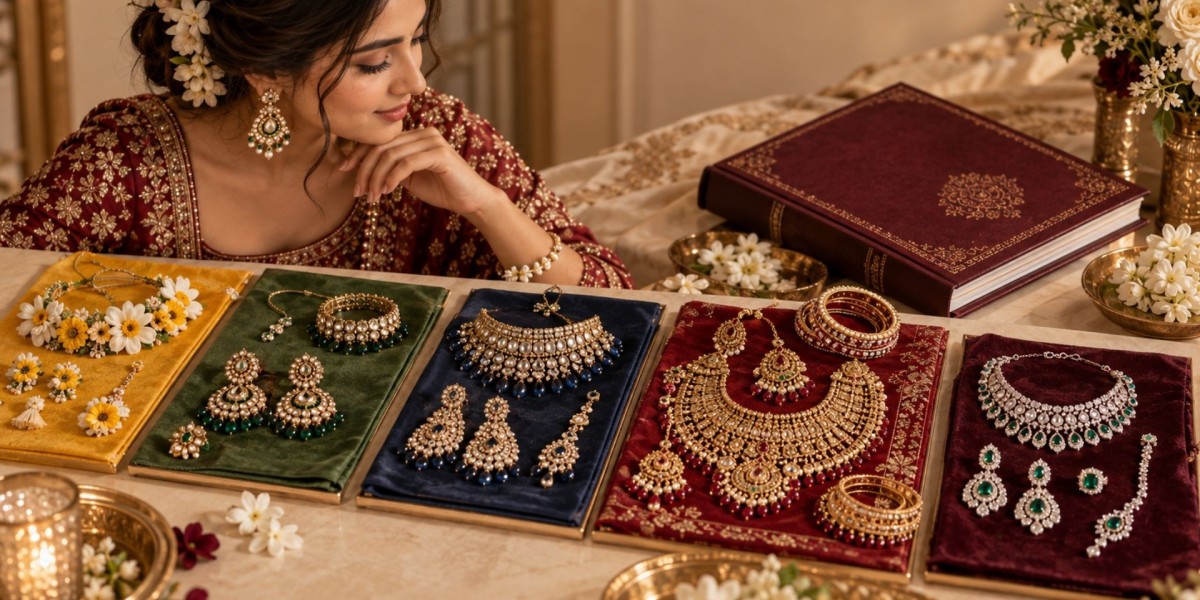

Indian weddings rarely happen in one outfit, one venue, or one mood. Your Haldi may be bright and relaxed, Mehendi colourful and intimate, Sangeet energetic, the wedding traditional, and the Reception more polished.
Your jewellery should change with each function too.
The goal is not to buy five completely different jewellery sets. It is to build a coordinated collection where every piece has a purpose, works with the outfit, feels comfortable and still reflects your personal style. Recent bridal styling guides also recommend matching jewellery to the mood, movement, lighting and outfit of each function rather than repeating the same heavy look throughout the wedding.
How should bridal jewellery change for different wedding functions?
The simplest rule is to match the jewellery to the function's energy. Daytime events usually suit lighter and more playful pieces, while the wedding and evening functions allow richer jewellery and stronger statement pieces.
| Wedding Function | Jewellery Style | Best Jewellery Choices | What to Prioritise |
|---|---|---|---|
| Haldi | Light and colourful | Floral jewellery, beads, pearls, lightweight gold | Comfort |
| Mehendi | Playful and detailed | Jhumkas, chandbalis, maang tikka, light layered necklaces | Hand movement |
| Sangeet | Glamorous and expressive | Kundan, Polki, statement earrings, chokers | Movement and photographs |
| Wedding | Traditional and complete | Bridal necklace, rani haar, jhumkas, bangles, maang tikka, nath | Tradition and balance |
| Reception | Refined and polished | Diamonds, elegant gold, emeralds, statement earrings | Evening elegance |
This function-wise approach also helps you avoid buying several pieces that serve exactly the same purpose.
What jewellery should you wear for the Haldi ceremony?
Haldi jewellery should feel light, cheerful and easy to wear. Since the ceremony involves turmeric, movement and close interaction with family and friends, delicate or highly elaborate jewellery often makes less practical sense.
Floral jewellery remains a natural choice for Haldi. Fresh flowers, beads, pearls, shells and lightweight colourful pieces work well with yellow, green, pink and pastel outfits.
Try:
- Floral earrings
- Floral maang tikka
- Lightweight jhumkas
- Pearl jewellery
- Beaded necklaces
- Small gold earrings
- Colourful bangles
- Lightweight statement rings
If your Haldi outfit already has strong embroidery, keep the jewellery simpler. If the outfit is plain, a colourful necklace or statement earrings can give the look more character.
The important thing is comfort. You should be able to sit, move, participate in rituals and enjoy the event without constantly adjusting your jewellery.
What jewellery should you wear for Mehendi?
Mehendi gives you more freedom to experiment with colour, texture and playful jewellery. Since your hands and arms are the focus during the Mehendi application, avoid covering them with too many pieces before the design is complete.
Statement earrings, maang tikka, lightweight necklaces and selected bangles work well. Current bridal styling guidance also recommends keeping the jewellery around the hands practical so it does not interfere with Mehendi application.
Good options include:
- Jhumkas
- Chandbalis
- Meenakari jewellery
- Kundan earrings
- Lightweight chokers
- Layered necklaces
- Maang tikka
- Minimal hathphool after the Mehendi is finished
- Colourful bangles
Mehendi is also a good function for introducing a jewellery colour you do not want to use on your wedding day. Emerald green, pink, turquoise, blue or multicolour stones can bring personality to the look.
If your Mehendi outfit is heavily patterned, choose one strong jewellery element instead of stacking everything together.
What jewellery should you wear for the Sangeet?
Sangeet is where your jewellery gets to become more expressive. Dancing, stage lighting and evening photography give you room for stronger pieces, but the jewellery still needs to stay secure and comfortable.
Kundan, Polki, statement earrings, chokers and layered necklaces work well with Sangeet outfits. The key is to choose pieces that stay in place while you move.
Try:
- Statement chandbalis
- Polki earrings
- Kundan chokers
- Layered necklaces
- Long danglers
- Statement rings
- Cuffs
- Maang tikka
- A single standout necklace
If you are wearing a sequinned or heavily embellished lehenga, let the jewellery support the outfit rather than compete with it.
For a simpler Sangeet outfit, you have more room for a dramatic necklace or larger earrings.
One useful rule is to test the jewellery before the event. Put it on, move your head, raise your arms, walk and sit down. Jewellery that looks beautiful while standing still is not useful if it keeps shifting once the music starts.
What jewellery should you wear for the wedding ceremony?
The wedding ceremony is where traditional bridal jewellery usually takes centre stage. Your jewellery should work with your bridal outfit, hairstyle, dupatta placement and cultural traditions.
Depending on your personal style and family traditions, your wedding look might include:
- Bridal necklace
- Choker
- Rani haar
- Matching earrings
- Maang tikka
- Nath
- Bangles
- Kadas
- Hathphool
- Waist belt or kamarbandh
- Bajubandh
- Rings
You do not need every piece.
A heavily embroidered lehenga might already provide enough visual detail. In such cases, a strong necklace, earrings and head jewellery might create a more balanced result than adding every traditional piece available.
Your face shape and hairstyle also matter. A large maang tikka, for example, interacts with your forehead, hairline and hairstyle. Earrings need to work with both your face and the necklace.
This is why bridal jewellery selection should happen as a complete look rather than one piece at a time.
What jewellery should you wear for the Reception?
Reception jewellery usually works best when it feels more edited than the wedding look. After several traditional wedding functions, a refined necklace, statement earrings or diamond jewellery gives the bride a different visual identity.
Recent reception styling guidance places emphasis on polished jewellery, statement necklaces, sculptural earrings and selective use of bracelets rather than repeating the full traditional bridal stack.
Good choices include:
- Diamond necklace
- Diamond earrings
- Emerald earrings
- Pearl jewellery
- Sleek gold necklace
- Sculptural earrings
- Tennis-style bracelet
- Cocktail ring
- Contemporary choker
If your reception outfit has a clean neckline, use it as an opportunity to highlight one major necklace.
If the outfit has an elaborate neckline, statement earrings might work better.
A useful formula is:
Heavy neckline = simpler earrings.
Simple neckline = stronger necklace.
Statement earrings = keep the necklace restrained.
This gives the look a clear focal point.
How do you match jewellery with your outfit for each function?
Start with the outfit rather than the jewellery.
Look at five things:
- Outfit colour
- Neckline
- Embroidery
- Fabric
- Overall visual weight
A pastel Mehendi outfit might work beautifully with pearls, colourful gemstones or delicate gold. A red wedding lehenga might support traditional gold, Kundan, Polki or gemstone jewellery.
For an evening reception, a satin saree, velvet blouse or structured gown often benefits from jewellery with clean lines and controlled sparkle.
The principle is simple: if the outfit is doing a lot, let the jewellery breathe. If the outfit is simple, jewellery has more room to become the focal point.
How do you choose jewellery according to your skin tone?
Your skin undertone gives you a useful starting point, but it should not become a strict rule.
Warm undertones often pair naturally with yellow gold and warm gemstone colours. Cool undertones often work well with white metals, diamonds and cooler gemstone colours. Neutral undertones give you more flexibility.
Your outfit still matters.
A bride with a warm undertone wearing a cool-toned reception outfit might prefer white gold or diamond jewellery for that particular look. Another bride with the same undertone might choose yellow gold because it better reflects her personal style and traditional bridal aesthetic.
The best approach is to consider skin undertone, outfit colour and the lighting of the event together.
This is one area where personalised styling becomes useful. Shaadinama's styling process checks undertone and then validates jewellery combinations against actual outfit colours and fabric references rather than relying on a generic skin-tone chart.
How much jewellery should you buy for each wedding function?
You do not need a completely separate jewellery set for every event.
Instead, build your collection around hero pieces, supporting pieces and function-specific additions.
For example:
Hero pieces:
Your main bridal necklace, important gold set or diamond jewellery.
Supporting pieces:
Earrings, bangles, rings and smaller necklaces that work across multiple outfits.
Function-specific pieces:
Floral jewellery for Haldi, colourful pieces for Mehendi or a statement accessory for Sangeet.
This approach gives you more styling options without forcing you to purchase five expensive sets.
You should also consider what you will wear after the wedding. A pair of diamond earrings or versatile gold bangles might work for weddings, festivals and family occasions for years. A highly specific statement piece might have value primarily because of the memories attached to it.
Both purchases have value. They simply belong in different parts of your budget.
How can you create different bridal looks without buying too much jewellery?
Use the same important pieces in different combinations.
A strong pair of earrings might work with your Mehendi outfit and Reception look. A Kundan necklace might work as a complete wedding set and later be paired with simpler earrings for another occasion.
You can also change the visual balance.
For example:
- Full necklace + matching earrings for the wedding
- Necklace + simple studs for another function
- Statement earrings + no necklace for the Reception
- Earrings + lighter necklace for Sangeet
This gives you distinct photographs and looks without creating unnecessary duplication.
Shaadinama uses a similar principle when building function-wise bridal looks. The styling process maps each outfit and function, builds complete jewellery combinations, then swaps and simplifies pieces so every look feels distinct while selected jewellery gets reused.
What should you consider before buying function-wise bridal jewellery?
Before purchasing anything, create a simple wedding jewellery checklist.
For every function, note:
- Outfit
- Outfit colour
- Neckline
- Hairstyle
- Function timing
- Jewellery style
- Main jewellery piece
- Supporting pieces
- Existing family jewellery
- New purchases
- Budget
- Reuse potential
Then try the complete combination together.
This matters because jewellery often looks different when worn with the full outfit. A necklace that looked perfect against a showroom display might sit too high on your neckline. Earrings might compete with your hairstyle. A maang tikka might feel too large once your hair and dupatta are styled.
Try the complete look before making your final decision.
How does Shaadinama help with bridal jewellery for different functions?
Shaadinama approaches bridal jewellery as a complete styling and buying decision rather than a collection of individual designs.
The process begins by understanding your wedding events, outfits, preferences and budget. It then maps your style, considers face shape, height, shoulder line and undertone, and builds function-wise looks for events such as Mehendi, Sangeet, Wedding and Reception.
The process also includes outfit and colour mapping, try-on and feedback, budget tiers, quality checks and a final jewellery checklist.
That matters when you are trying to answer the bigger question: “What jewellery is right for me?”
You do not need more jewellery inspiration. You need a plan for deciding what belongs in your wedding wardrobe.
Final bridal jewellery checklist
Before you finalise your wedding jewellery, check:
- Does each piece have a specific function?
- Does it work with the outfit neckline?
- Does the jewellery balance the outfit's embroidery?
- Is it comfortable enough for the full event?
- Does the colour work with the outfit?
- Does the metal suit the overall styling?
- Have you considered your skin undertone?
- Can you reuse any important pieces?
- Have you included existing family jewellery?
- Does every major purchase fit your budget?
- Have you checked the quality and relevant documentation?
- Have you tried the complete look with the actual outfit?
The best bridal jewellery plan is not the one with the most pieces. It is the one where every piece has a reason to be there.
For personalised guidance across your wedding functions, explore Bridal Jewellery through Shaadinama and build your looks around your outfits, preferences and budget.