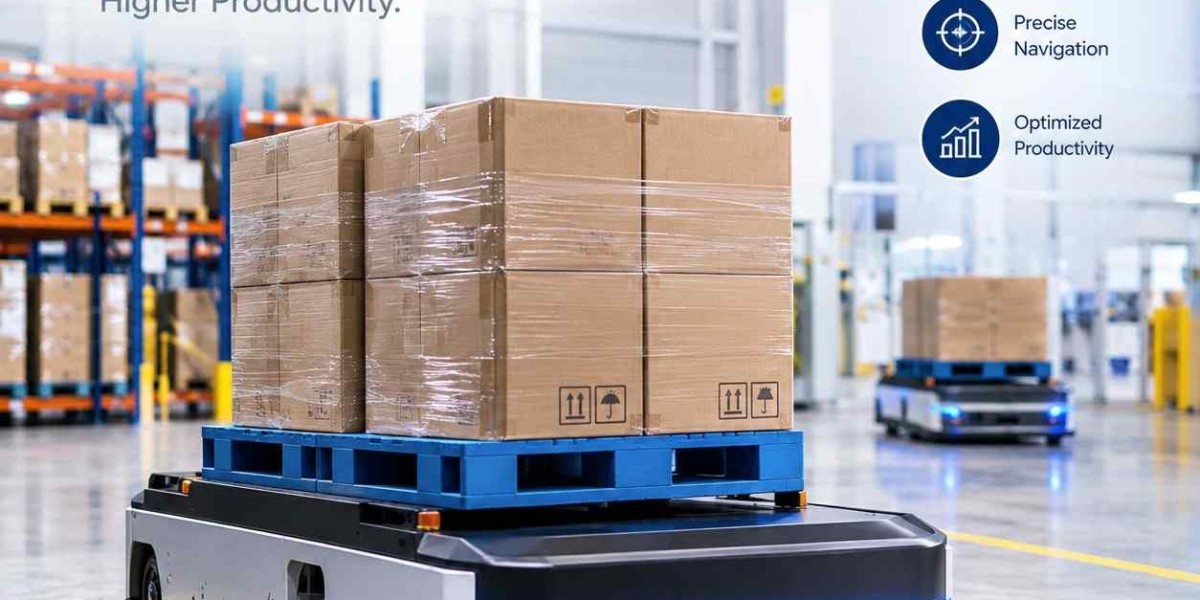

A pallet reaches the production line late, a forklift is tied up elsewhere, and two operators are pulled away from their actual jobs to move material. That small delay repeats dozens of times a day. This is where an Automated Guided Vehicle can create measurable value—not because it replaces every material-handling task, but because it takes repetitive transport out of the daily bottleneck.
Where Automated Guided Vehicle Specifications Actually Matter
Payload, speed, and positioning are only the starting point
An AGV project begins with the load. A unit-load vehicle may move pallets or bins, while tow AGVs can pull multiple loads and forklift AGVs can handle palletized material. Airox lists tow, unit-load, forklift, and customized AGV configurations.
Here's the detail buyers often skip: floor condition and turning radius.
Supplier Checks That Protect the Purchase
1. Application engineering
A good Automated Guided Vehicle Manufacturer asks about payload, route length, shift pattern, floor condition, traffic, and pickup/drop points.
A bad answer is: “Send the load weight and we'll quote.”
That is not engineering. It is pricing before understanding the application.
2. Safety architecture
Ask how obstacle detection, emergency stops, warning zones, and collision avoidance work.
A bad answer is: “The AGV has sensors.”
That tells you almost nothing. Airox lists laser scanners, ultrasonic sensors, emergency stops, collision avoidance, and audible and visual alarms among its specifications.
3. Software integration
Ask which communication methods and factory systems are supported.
A bad answer is: “Our software can integrate with anything.”
Get the actual interface requirements in writing. Airox lists Wi-Fi, Ethernet, 5G-enabled communication and compatibility with WMS, ERP, and MES systems.
Benefits That Show Up in the Factory's Numbers
Fewer repetitive handling movements
Repeated pallet and component movement consumes labour hours. An AGV can take predictable transport cycles away from operators, allowing labour to be used for tasks that require judgment or manual intervention.
Lower handling-related risk
A controlled vehicle route can reduce unnecessary forklift and pedestrian interaction. That matters particularly in busy production and warehouse areas.
Better material-flow consistency
If a production line needs components at defined intervals, automated transport can follow scheduled missions instead of relying entirely on manual requests.
Availability: Choosing an Automated Guided Vehicle Manufacturer in India
For Indian buyers, location is more than a line on a quotation. It affects commissioning, service visits, spare-part movement, travel costs, and response time.
Airox has a PAN-India service network according to its corporate information, while its AGV range is positioned for manufacturing, warehousing, healthcare, logistics, and other industrial applications.
That makes local technical coverage worth checking before purchase. Automated Guided Vehicle Suppliers in India should be evaluated not only on the vehicle itself, but also on how quickly technical support can reach the operating site.
About Airox Technologies
We approach industrial automation from a practical engineering perspective. Our focus is not simply putting an AGV on the factory floor; we look at payload, route, floor conditions, safety, charging, controls, and the way the vehicle fits into existing material movement.
Our broader engineering business has been operating since 2012, with more than 1,200 installations across our technology portfolio and a PAN-India service network.
CTA: Send the Information We Need for an AGV Quote
We can assess your requirement faster if you send the payload weight, vehicle type, travel distance, floor type, aisle width, lifting height, number of trips per shift, working hours, and preferred navigation method.
Our published AGV range includes payload capacity up to 5,000 kg, travel speed up to 2 m/s, lifting height up to 6,000 mm, and positioning accuracy up to ±10 mm.
Conclusion
The right Automated Guided Vehicle creates value where material movement is repetitive, measurable, and costly to manage manually. Payload, route, safety, software integration, floor conditions, and service support should all be assessed before the purchase order is released. The strongest projects start with the material-flow problem rather than the machine. As Indian factories automate further, AGV selection will increasingly become a production-planning decision, not simply an equipment purchase.
FAQs
What is an Automated Guided Vehicle, and where does it deliver the most value?
An AGV is an automated vehicle used to transport materials such as pallets, containers, components, and finished goods within a facility. It delivers the most value where transport is repetitive, routes are predictable, and manual handling consumes significant time. Airox lists payloads up to 5,000 kg across its AGV specifications.
How do I choose an Automated Guided Vehicle Manufacturer in India?
Start with application engineering, not price. Ask the Automated Guided Vehicle Manufacturer in India about payload, route design, floor conditions, battery operation, safety functions, software integration, installation, and after-sales service. A low initial price is not necessarily economical if commissioning support is weak.
What should I ask Automated Guided Vehicle Suppliers in India before ordering?
Ask for the complete technical specification, including vehicle type, payload, travel speed, navigation method, battery, charging arrangement, safety system, communication protocol, dimensions, and maintenance requirements. Automated Guided Vehicle Suppliers in India should also explain what is included in installation and commissioning.
Are Automated Guided Vehicle Suppliers suitable for small factories?
They can be, but the economics depend heavily on route frequency, labour usage, payload, and operating hours. An AGV is not automatically profitable because the factory has a material-handling problem. A short or irregular route may not justify automation, so a proper movement study should come first.
How do I compare Automated Guided Vehicle Exporters in India?
Check whether the exporter can supply the required documentation, electrical configuration, software support, spare parts, and service coverage in your destination market. Automated Guided Vehicle Exporters in India can support international projects, but export capability alone does not prove that the system is suitable for your application.