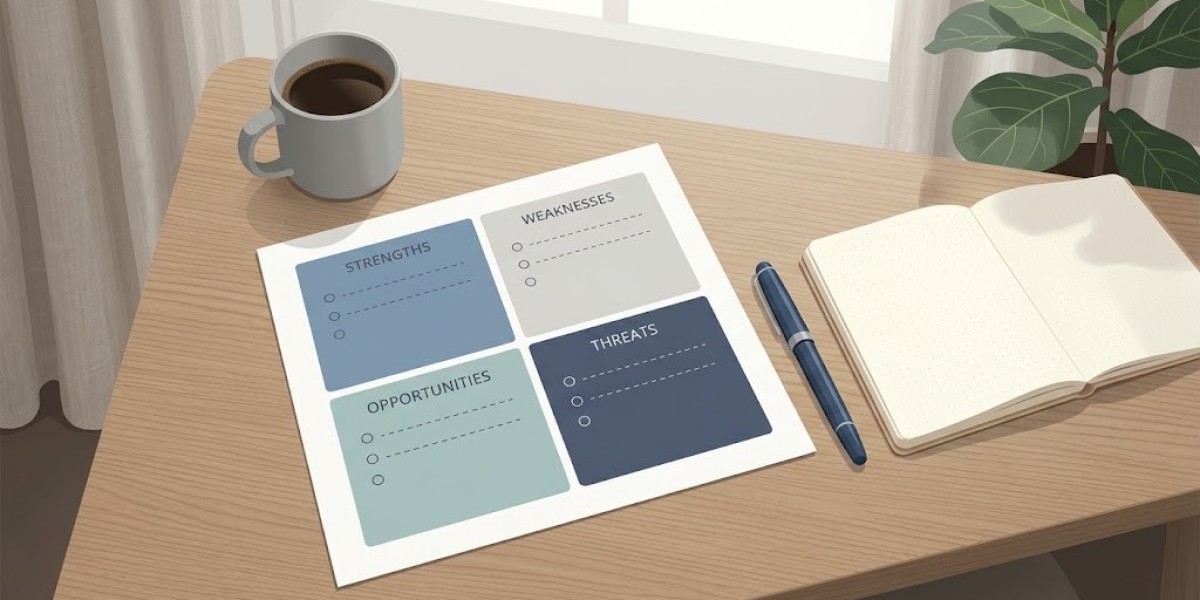

You've filled every box. Strengths, weaknesses, opportunities, threats all ticked off, all looking neat on the page. And yet you're still sat there wondering what you're actually meant to say about any of it. If that sounds familiar, you're not doing anything wrong. You've just hit the point where most students get stuck, and it's worth understanding why.
That stuck feeling usually comes from treating SWOT as a sorting exercise spot something, drop it in a box, move on. But a business doesn't run in four separate compartments. Its strengths shape how it handles its weaknesses. A shift in the market can open a door and expose a crack at the same time. Everything talks to everything else, and the grid on its own doesn't show you that.
So the real question was never "what goes in each box?" It's "what does this actually tell me about the business?" Once you start asking that instead, the whole exercise gets a lot less frustrating and a lot more interesting.
The Boxes Are a Starting Point, Not the Finished Product
Picture a small independent clothing brand with a loyal following. Calling that a strength is fair enough, but leaving it there tells your reader almost nothing they didn't already guess. What can the business actually do because people trust it? Maybe shoppers are more willing to try a new product line. Maybe that trust gives the brand a fighting chance against bigger, better-funded competitors.
That's the shift from spotting something to explaining it and it's where the real marks live.
The same logic runs through every quadrant. A weakness only matters because of what it blocks. A threat only matters because of how it might unsettle the business's current footing. Once you push past naming things and start asking what they do, the analysis stops feeling like a checklist and starts feeling like an argument.
Work Out Where the Factor Is Actually Coming From
Most students can recite the rule fine: strengths and weaknesses live inside the business, opportunities and threats come from outside it. Simple enough, until a real case turns up and the line gets blurry fast.
Take a firm facing fast-moving changes in digital tech. That shift is external nobody at the company caused it. But how the business responds? That's entirely internal. A team with the right digital skills might turn that shift into a genuine strength. A team clinging to outdated systems could see the exact same trend expose a serious gap.
This is why memorising the four definitions only gets you halfway. Ask where a factor comes from, then ask how well the business is positioned against it. That second question is usually where the more interesting story sits.
A Vague Strength Barely Counts as One
"Good customer service" reads well but says almost nothing. What actually makes it good? Do complaints get sorted quickly? Do people come back specifically because of how they were treated? Is there something here competitors genuinely can't copy?
The same goes for phrases like "strong marketing" or "poor management" technically true of hundreds of businesses, and useful to none of them without detail. Compare that to something like a café known locally for handling a packed lunchtime rush without ever losing its head. That's specific. That tells you something you can actually use.
A decent habit is to challenge every single point with "why?" If you can't answer without reaching for another vague phrase, the point isn't finished yet it just looks finished.
The Best Insights Sit Between the Boxes
Here's where SWOT genuinely earns its keep. Say that same clothing brand has a loyal online customer base a strength while demand for sustainable clothing is rising in a market it hasn't entered yet an opportunity. Neither point means much sitting alone.
But put them together and the picture sharpens. That loyal base gives the business a decent read on what people actually value, which could help it test the new market with less risk. Now add a third fact: the company already struggles to get existing orders out on time. Suddenly that opportunity looks a lot less straightforward.
The opportunity hasn't vanished its meaning has changed. That's the bit worth remembering: an opportunity isn't automatically worth chasing just because it exists. A business needs the capacity, the know-how, and the timing to actually use it, and threats work exactly the same way in reverse.
Not Every Point Deserves Equal Weight
A SWOT with fifteen bullet points can look thorough and still say less than one with three points properly worked through. Picture a firm with a well-known brand, a market growing fast, and production capacity that's already stretched thin.
All three matter. But it's the relationship between them that actually tells the story a brand pulling in demand the business can't fully meet is a far more useful thing to flag than three separate, disconnected facts sitting politely next to each other.
If you're working through a case study and finding it genuinely difficult to see how the pieces connect, that's usually a sign you need a proper second pair of eyes on the structure rather than more bullet points which is exactly the kind of thing SWOT Analysis Assignment Help UK exists for, especially when a deadline's creeping up and the framework itself feels clearer than what to actually do with it.
Look for the Tension That Explains the Business
Sometimes the sharpest insight is hiding inside a contradiction. A brilliant product held back by weak distribution. Skilled staff working with technology that's years out of date. A growing market the business can't afford to properly enter yet.
Take a bakery that's become the talk of the neighbourhood but can only bake so much each morning. Rising demand sounds like nothing but good news until regulars keep turning up to empty shelves. The opportunity and the weakness aren't separate stories. They're the same story, told from two angles, and spotting that connection is worth more than another five bullet points ever will be.
The Real Test: Does the Grid Actually Explain Anything?
Before calling it finished, step back and read your findings as if you'd never heard of the business before. Can you tell what it does well? Where it's exposed? Which outside changes actually matter to it? And this is the bit most analyses skip can you see how those pieces connect?
If every point still stands alone, there's another layer waiting to be found. Ask what each strength genuinely makes possible. Ask what each weakness quietly rules out. That's the difference between listing information and actually interpreting it.
That's the real point of a SWOT analysis: not proving that a business has strengths, weaknesses, opportunities and threats every business does but showing what those things mean once you look at them together. Get that far, and the four boxes stop feeling like separate homework tasks. They start feeling like one connected picture of a business under pressure from every direction at once.