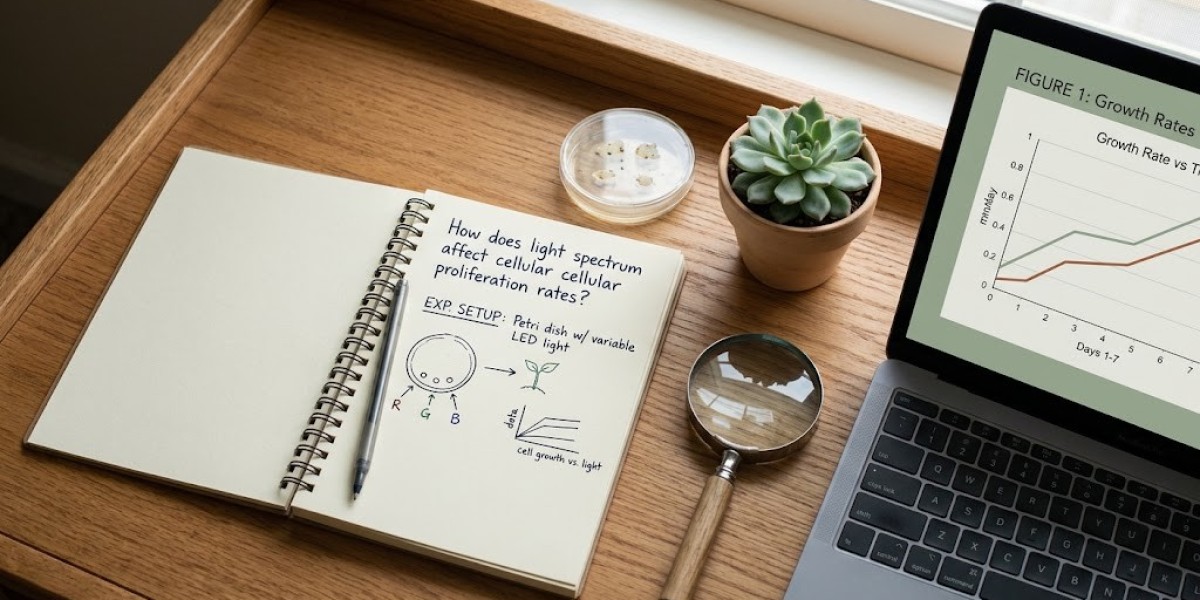

Most students don't fail their research project because they picked a boring subject. They fail because they picked a subject that sounded interesting on a Tuesday afternoon and turned out to be impossible to study properly with the time, equipment and access they had. The idea was fine. The scope was the problem.
That distinction matters more than almost anything else in the early stages of a biology project. A topic can be scientifically fascinating and still be the wrong choice for you, right now, given your resources. Learning to tell an interesting question apart from an investigable one is the real skill here not finding inspiration, but testing it before you commit.
Why the obvious approach usually goes wrong
The instinctive method is to start broad: pick a field you like genetics, ecology, microbiology and narrow it down until something feels specific enough to write about. This feels logical, but it tends to produce topics that are only specific in wording. "The effect of pollution on marine biodiversity" sounds narrower than "marine biodiversity," yet it still describes a decade of possible research, not a term paper.
The deeper issue is that narrowing by subject matter alone skips over the real constraint, which is method. A question becomes researchable once you know how you'd answer it what you'd measure, observe, compare or test, and with what. Students often work backwards from this. They settle on a question first, and only weeks later discover that answering it would need equipment, populations, time spans or ethical approvals they simply don't have.
Start from what you can actually do
Before settling on a direction, take an honest inventory of your practical situation. What lab access do you have? What organisms or samples could you realistically obtain? Does your project need primary data, or could it work from existing datasets? How much time do you genuinely have once teaching weeks, other assignments and inevitable delays are factored in?
None of this is a compromise on ambition it's the filter that turns vague enthusiasm into a workable plan. Take a student interested in animal behaviour who has no lab access to animals. That interest doesn't have to be abandoned. They might instead analyse existing behavioural datasets, or design an observational study using a local population birds in a nearby park, say, or invertebrates in a garden bed. The subject stays the same. Only the method has to bend.
The trap of "it's already been studied"
Plenty of students discard promising ideas because a quick search shows the subject has already been researched. Most of the time, this reasoning falls apart under scrutiny. Almost everything in biology has been studied in some form. The real question isn't whether the subject is new it's whether your specific angle, population, variable or comparison adds something existing work hasn't quite covered.
Undergraduate and school-level research rarely needs to be original in the sense of a scientific breakthrough. What it needs is a version of the question that's genuinely yours, answered with evidence you've actually gathered. Once you stop hunting for an untouched subject and start looking for an underexplored angle on an established one a different location, a different time frame, a combination of variables nobody happened to test together good ideas tend to show up faster than expected.
Turning a broad interest into a testable question
Once you have a rough area and a realistic sense of your constraints, the next step is converting interest into a question with a clear, checkable answer. A useful test: could this question, in principle, produce a result that surprises you? If it can only confirm what you already assume, it's probably too vague, or too obvious, to justify a research project. It's a topic wearing a question mark, not an actual inquiry.
Strong questions usually involve a comparison, a relationship, or a change across some condition how one variable relates to another, how two groups differ, how a process shifts under specific circumstances. Weak ones tend to hide inside descriptive phrasing that needs no real data behind it: "an overview of," "the role of," "an exploration of." Treat those phrases as a warning sign. They describe a topic rather than a question, and a project built around one usually turns into background reading padded out to look like research.
This is also where the practical side of picking Biology Research Topics quietly shapes the intellectual side. A tightly defined, testable question is almost always more investigable than a broad, impressive-sounding one, simply because it tells you what data you need and what would actually count as an answer.
Recognising when an idea needs to change
Even a well-chosen question can go wrong once the work starts, and knowing when to adjust matters as much as the original choice. One warning sign: your literature search keeps turning up review articles and general summaries but almost no primary studies. That usually means the question is too broad or too abstract to have been tested directly, which will make your own methodology hard to justify later.
Another sign shows up when every method you consider needs resources, timescales or sample sizes well beyond what you actually have. Rather than dropping the topic altogether, treat this as a cue to shrink the scope one mechanism instead of a whole system, one species instead of an ecosystem, one variable instead of a tangle of interacting ones. Depth on a narrow question beats shallow coverage of a wide one almost every time, and it's far easier to write convincingly about something you've actually managed to measure properly.
There's a third sign that gets talked about less: boredom with your own question by the end of the first week of reading. That's not usually a character flaw. More often it means the question got chosen for how it sounded rather than what it actually asked you to find out. Questions that stay interesting under scrutiny tend to sit on top of a genuine uncertainty something you don't already know the answer to rather than a fact you're just gathering evidence to restate.
What separates a workable project from a weak one
Students who end up with strong biology projects aren't necessarily the ones with the most original ideas. They're the ones who matched their question to their method early, kept the scope small enough to actually finish, and stayed willing to revise the question once early reading or preliminary data suggested it. Genetics, ecology, physiology, microbiology the subject matter barely matters here. What matters is whether you narrowed and tested rather than just narrowed.
One habit is worth building before committing to anything: write your working question down, then write next to it exactly how you'd answer it what you'd measure, compare or observe, and with what. If that second part comes out vague, the question isn't ready, however compelling it sounds on its own. Once both halves hold up, the choice stops being abstract. You're no longer picking a topic. You've already started the research.