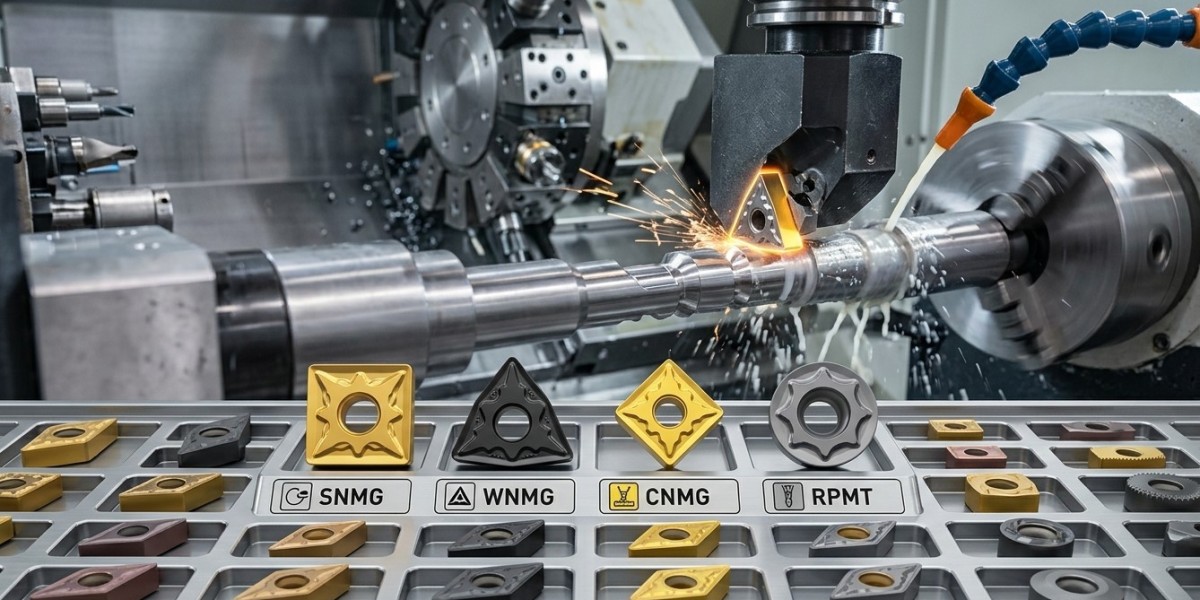

Choosing the right CNC insert is an important part of achieving accurate, efficient, and consistent machining results. CNC inserts are responsible for removing material from the workpiece, and their geometry, grade, coating, shape, and size can significantly affect cutting performance, surface finish, tool life, and production costs. Using an unsuitable insert can lead to excessive tool wear, vibration, poor chip control, dimensional inaccuracies, and unexpected production downtime.
For manufacturing companies, engineering workshops, and CNC machining operations, selecting the correct insert should be based on the workpiece material, machining operation, cutting conditions, machine capability, and required finish. Khokhawala Trading LLC , an established Industrial Tools Supplier in Dubai , provides a range of industrial cutting tools, carbide cutting tools, CNC machining tools, and machining accessories for different industrial applications.
What Are CNC Inserts?
CNC inserts are replaceable cutting tips used in indexable cutting tools. Instead of replacing an entire tool when the cutting edge becomes worn, operators can replace or rotate the insert, depending on its design.
CNC inserts are commonly used for:
- Turning
- Facing
- Grooving
- Parting
- Threading
- Milling
- Boring
- Profiling
Most industrial inserts are manufactured from carbide or other advanced cutting materials and may include specialized coatings designed to improve wear resistance, heat resistance, and cutting performance.
The ability to replace an insert quickly makes indexable tooling particularly useful in production environments.
Why Correct CNC Insert Selection Matters
A CNC insert is a small component, but it has a major influence on the machining process.
The correct insert can help provide:
- Longer tool life
- Improved surface finish
- Better chip control
- Consistent dimensions
- Higher productivity
- Reduced cutting forces
- Fewer tool changes
- More predictable machining costs
In contrast, an inappropriate insert may wear quickly or produce unstable cutting conditions.
For this reason, insert selection should be treated as part of the overall tooling strategy rather than simply choosing the most durable-looking insert.
Consider the Workpiece Material
The first step in selecting a CNC insert is identifying the material being machined.
Different materials create different cutting conditions and require different insert geometries and grades.
Steel
Steel is widely machined in turning and milling operations. General-purpose carbide inserts are commonly used, but the appropriate grade and geometry depend on hardness, cutting speed, and whether the operation is roughing or finishing.
Stainless Steel
Stainless steel can generate heat and may have a tendency to work harden. Inserts designed for stainless steel can provide suitable cutting geometry and chip control for these conditions.
Cast Iron
Cast iron can generate abrasive wear and produce discontinuous chips. Insert grades designed for wear resistance may be appropriate depending on the specific material and operation.
Aluminum
Aluminum is generally softer than steel but can adhere to cutting edges. Sharp cutting geometries and suitable surface treatments can help produce efficient cutting and good surface finish.
Hardened Materials
Hard materials place greater demands on cutting tools. Depending on hardness and operation, specialized carbide, ceramic, or other advanced cutting materials may be required.
Select the Insert According to the Machining Operation
The machining operation also determines the appropriate insert.
Turning Inserts
Turning inserts are available in various shapes and geometries for roughing, finishing, profiling, and general-purpose applications.
A roughing operation may require a stronger cutting edge, while finishing typically requires geometry optimized for surface quality and dimensional control.
Milling Inserts
Indexable milling cutters use replaceable inserts for face milling, shoulder milling, high-feed milling, and other operations.
The insert should match the cutter body and the specific milling application.
Grooving Inserts
Grooving inserts are designed to produce narrow grooves with controlled width and depth. Their geometry is particularly important for chip evacuation and cutting stability.
Threading Inserts
Threading inserts are manufactured for specific thread profiles and standards. The insert must match the required thread form, pitch, and application.
Boring Inserts
Boring operations require inserts that can work effectively within a restricted space. Tool geometry and clearance become particularly important for internal machining.
Understanding Insert Shape and Geometry
Insert shape influences cutting strength, accessibility, and cutting forces.
Common insert shapes include:
- Triangle
- Diamond
- Square
- Round
- Trigon
- Rectangle
Stronger vs. More Accessible Shapes
Larger included angles generally provide stronger cutting edges, while sharper-pointed geometries can provide better access to complex profiles.
For example, a square insert can provide multiple usable cutting edges and good strength for suitable operations, while a diamond-shaped insert may provide better access for profiling.
The correct shape depends on the workpiece geometry and cutting direction.
Choose the Correct Insert Clearance Angle
Clearance angle determines how the insert's cutting edge interacts with the workpiece.
A positive clearance geometry can reduce cutting forces and may be useful when machining smaller or less rigid components.
A negative geometry can provide a stronger cutting edge and is often used for demanding operations on rigid machines.
The choice should consider machine rigidity, workpiece stability, material, and cutting conditions.
Understand Insert Grade
Insert grade refers to the characteristics of the cutting material and its suitability for particular machining conditions.
Different grades may prioritize:
- Wear resistance
- Toughness
- Heat resistance
- Shock resistance
- High-speed performance
A highly wear-resistant grade may be useful for stable, continuous machining, while a tougher grade may be more appropriate for interrupted cuts where the cutting edge experiences impact.
The Importance of Insert Coatings
Many carbide cutting tools use coated inserts to improve performance.
Common coating technologies can provide improved resistance to:
- Abrasion
- Heat
- Adhesion
- Chemical wear
Coating selection should correspond to the workpiece material and machining application.
For example, coatings suitable for steel may not necessarily provide the same performance when machining aluminum or other non-ferrous materials.
Roughing vs. Finishing Inserts
Machining operations are often divided into roughing and finishing stages.
Roughing
Roughing removes large amounts of material quickly. The insert should have sufficient edge strength and be capable of handling higher cutting forces.
Important considerations include:
- Strong cutting edge
- Suitable depth-of-cut capability
- Effective chip breaking
- Resistance to impact and wear
Finishing
Finishing focuses on achieving the required dimensional accuracy and surface finish.
Finishing inserts may use sharper geometries and smaller nose radii, depending on the application.
The insert should be selected according to the required tolerance and surface quality rather than simply maximizing material removal.
Consider Nose Radius
Nose radius is the rounded portion at the cutting point of many turning inserts.
A larger nose radius can provide a stronger edge and may improve surface finish under suitable conditions. However, it can also increase cutting forces.
A smaller nose radius can reduce cutting forces and provide better access to certain profiles, but it may be more vulnerable to damage under heavy cutting conditions.
Therefore, nose radius should be selected according to workpiece rigidity, depth of cut, feed rate, and required finish.
Choose the Correct Insert Size
Insert size should be appropriate for the tool holder, workpiece, cutting depth, and machine capability.
Larger inserts may provide greater edge strength, while smaller inserts can offer better access to compact features.
The insert must also be compatible with the selected tool holder or cutter body. Always verify insert dimensions and specification codes before installation.
Cutting Speed and Feed Rate
Even the correct insert can perform poorly when cutting parameters are unsuitable.
Cutting speed affects heat generation and tool wear. Feed rate influences cutting forces, chip thickness, and surface finish.
The correct parameters depend on:
- Workpiece material
- Insert grade
- Insert geometry
- Cutting operation
- Machine rigidity
- Depth of cut
- Coolant conditions
Manufacturers' recommendations should be used as a starting point, followed by controlled adjustments based on actual machining conditions.
Consider Machine and Workholding Rigidity
Machine rigidity and workholding also influence insert performance.
A rigid CNC machine with secure workholding can generally support more demanding cutting conditions. A less rigid setup may require sharper or tougher geometries and more conservative parameters.
Proper CNC tool holders, chucks, vises, and other machining accessories can help reduce vibration and improve cutting stability.
If the workpiece moves during machining, even a high-quality insert may experience premature wear or breakage.
Chip Control Is Essential
Effective chip control is particularly important in CNC production.
Uncontrolled chips can:
- Damage the workpiece surface
- Interfere with the cutting process
- Wrap around the tool
- Increase heat
- Create safety problems
- Interrupt automated machining
Insert chip breakers and suitable cutting parameters can help produce chips that are easier to evacuate.
The ideal chip shape depends on the material, operation, feed rate, and depth of cut.
Common Mistakes When Choosing CNC Inserts
Several mistakes can reduce insert performance.
Choosing Only by Price
A low-cost insert may not provide the required tool life or productivity. The total cost should be considered in relation to machining performance and tool changes.
Ignoring Workpiece Material
An insert designed for one material may not perform effectively on another.
Using the Wrong Geometry
Incorrect geometry can increase cutting forces, vibration, and tool wear.
Using Incorrect Cutting Parameters
Even the right insert can fail if speed, feed, or depth of cut is inappropriate.
Ignoring Tool Holding
Poor tool holding can cause runout, vibration, and instability.
Continuing to Use Worn Inserts
A worn insert can compromise surface finish and dimensional accuracy and may eventually damage the workpiece.
How to Improve CNC Insert Performance
To get consistent results from CNC machining tools , workshops should:
- Identify the workpiece material accurately.
- Select the insert according to the machining operation.
- Choose suitable geometry and clearance.
- Match the insert grade to cutting conditions.
- Select the appropriate coating.
- Use suitable cutting speed and feed.
- Maintain rigid workholding.
- Minimize tool overhang.
- Monitor insert wear regularly.
- Verify finished dimensions with precision measuring tools .
This systematic approach can improve tool life while maintaining consistent production quality.
Signs That an Insert Needs Replacement
Operators should monitor inserts for signs of deterioration, including:
- Excessive flank wear
- Chipping
- Cracking
- Crater wear
- Poor surface finish
- Increasing cutting forces
- Dimensional variation
- Excessive heat
- Unusual vibration
- Changes in chip formation
Replacing an insert at the appropriate point can prevent damage to the workpiece and reduce unexpected downtime.
Benefits of Selecting the Right CNC Inserts
Correct insert selection can provide several benefits:
- Improved machining accuracy
- Longer cutting tool life
- Better surface finish
- More consistent chip control
- Reduced downtime
- Lower tooling consumption
- Higher production efficiency
- Better machine utilization
- Reduced risk of tool failure
- More predictable manufacturing costs
For production environments, these benefits can have a significant impact on overall machining efficiency.
Conclusion
Selecting the right CNC insert requires consideration of the workpiece material, machining operation, insert shape, geometry, clearance angle, grade, coating, nose radius, size, cutting parameters, and machine rigidity. No single insert is suitable for every application, so tooling should always be selected according to the specific machining conditions.
Using the correct insert alongside suitable industrial cutting tools , CNC machining tools , CNC tool holders, and machining accessories can help manufacturers achieve better tool life, surface finish, dimensional consistency, and productivity.
For businesses looking for reliable industrial tooling solutions, Khokhawala Trading LLC offers a range of cutting tools, carbide tooling, machining accessories, and precision measuring tools for engineering and manufacturing applications. As an established Industrial Tools Supplier in Dubai , Khokhawala Trading LLC supports workshops and industrial businesses with tooling solutions designed to meet diverse machining requirements.
The right CNC insert is not simply a replaceable cutting edge—it is an important component of the complete machining process. Careful insert selection can help manufacturers achieve stable cutting performance, efficient production, and consistent component quality.