
Bulk SMS Service vs Google RCS Messaging Service: Which One Should Your Business Use?
Introduction
A business needs to send a message to thousands of customers. But which channel should it use? A plain text message reaches almost every phone, no matter how old. A rich, interactive message looks better and gets more attention, but it needs a newer phone to work properly.
This is the real choice businesses face between Bulk SMS Service and Google RCS Messaging Service. Both send messages to large customer lists, but they work in very different ways. In this guide, you will learn what each service does, how they differ, and which one fits your business needs best.
What Is Bulk SMS Service?
Bulk SMS Service sends a plain text message to a large group of phone numbers at once. It works on every mobile phone, from the oldest keypad phone to the newest smartphone, because it uses the basic SMS network.
Businesses use bulk SMS for short, direct messages like OTPs, order updates, and quick reminders. The message is simple text, usually under 160 characters, with no images or buttons involved.
What Is Google RCS Messaging Service?
Google RCS Messaging Service is a richer, more visual way to message customers. It works inside the Android messaging app and can include images, buttons, and a verified business name, all within one message.
Businesses use RCS when they want the message to feel more like an app experience. A customer can tap a button to confirm an order or view a product image, all without leaving their chat app. Unlike SMS, RCS needs the customer's phone to support the RCS feature, usually a newer Android device with an active internet connection.
How Do They Work? A Side-by-Side Look
Both services follow a similar basic flow, but the message itself works very differently once it reaches the customer.
With Bulk SMS Service, a business writes a short text message, uploads a contact list, and the system sends it out over the mobile network. The customer sees it as a plain text in their default messaging app, no internet needed.
With Google RCS Messaging Service, a business creates a rich message with images or buttons, sets up a verified sender profile, and the system sends it over mobile data or Wi-Fi. The customer sees it inside their normal Android messaging app, but with visuals and tap-to-act buttons. If their phone doesn't support RCS, the message usually falls back to a plain SMS automatically.
Key Differences: Bulk SMS vs Google RCS
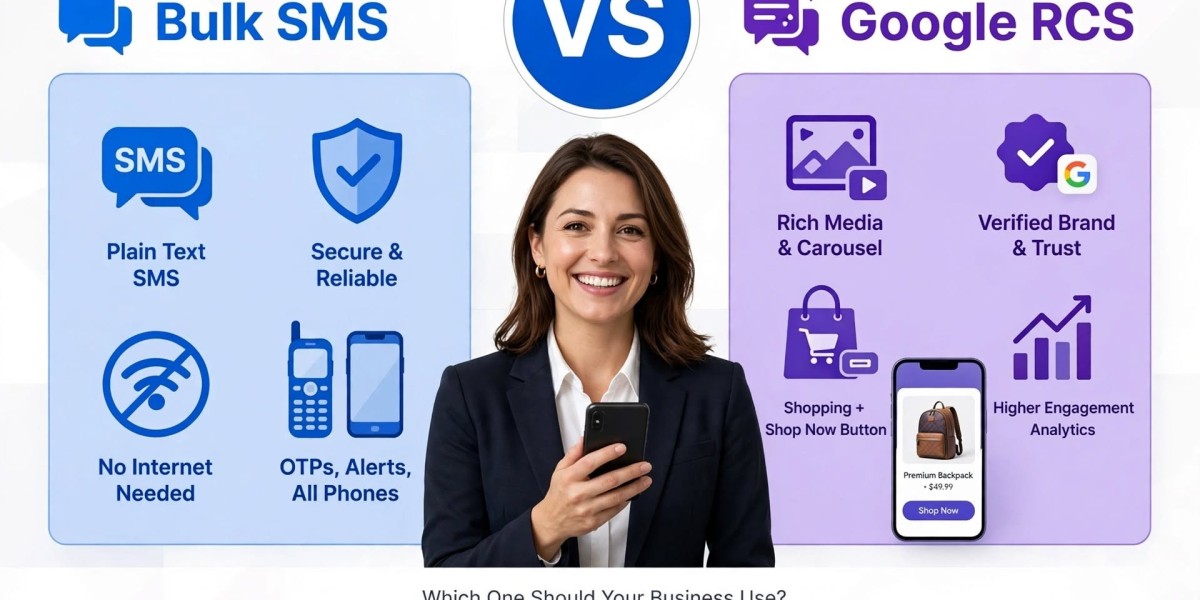
Feature | Bulk SMS Service | Google RCS Messaging Service |
Main purpose | Short, direct text messaging | Rich, interactive messaging |
Customer experience | Plain text, works everywhere | Visual, app-like, branded |
Media support | Text and links only | Images, video, carousels, buttons |
Device requirement | Any mobile phone | Newer Android phone with RCS support |
Network requirement | Works without internet | Needs mobile data or Wi-Fi |
Sender identity | Number only | Verified name, logo, and badge |
Business use | OTPs, alerts, quick reminders | Marketing, product showcases, support |
Best suited for | Reaching every customer, every device | Engaging customers visually |
Where Bulk SMS Wins
Bulk SMS still holds a clear advantage in a few important areas. It reaches every phone, including basic feature phones that can't run apps or use data. It doesn't need internet access, so it works even in areas with weak network coverage. It's also the standard choice for OTPs and time-sensitive alerts, since almost every customer can receive and read an SMS instantly.
For a business that needs a message to reach absolutely everyone on its list, regardless of phone type or internet access, Bulk SMS Service remains the more dependable option.
Where Google RCS Wins
Google RCS Messaging Service wins when the goal is engagement, not just delivery. A product photo, a "Buy Now" button, or a map location inside the message can turn a simple notification into something the customer actually interacts with. The verified sender badge also builds more trust, since customers can see the real business name and logo before opening the message.
For businesses running promotional campaigns, showcasing products, or wanting a more branded, professional look to their messages, RCS offers features that plain SMS simply cannot match.
Which One Should Your Business Use?
The honest answer is that most businesses benefit from using both, not choosing one over the other permanently.
Use Bulk SMS Service for OTPs, urgent alerts, and messages that must reach every single customer, no matter their device. Use Google RCS Messaging Service for promotional campaigns, product updates, and messages where visuals or quick-reply buttons would genuinely help the customer take action.
A common setup is to send an RCS message first, since it offers a richer experience, and let it automatically fall back to SMS for customers whose devices don't support RCS. This way, no customer is left without a message, while those with newer phones still get the richer version.
How These Services Work With Other Communication Channels
Both SMS and RCS often work alongside other tools rather than standing alone. The Toll-Free Service gives customers a free number to call if they have questions after receiving a message, which works well for both channels. For urgent updates, the Bulk Voice Service can reinforce a text or RCS message with a spoken reminder, reaching customers who may not check their phone messages right away.
This combination helps businesses cover more ground, since not every customer responds the same way to every channel.
Why Choose Mishtel for Bulk SMS and Google RCS Messaging?
Mishtel offers both Bulk SMS Service and Google RCS Messaging Service, so businesses can choose the right channel for each message, or use both together for wider reach.
The platform supports contact list management, scheduled sending, and delivery tracking across both services, along with automatic fallback from RCS to SMS when needed. This means businesses don't have to manage two separate systems just to cover different types of messages. Mishtel's messaging tools can also work alongside other services on the platform, including toll-free numbers and bulk voice calling, for a more complete communication setup.
Conclusion
Bulk SMS Service and Google RCS Messaging Service both help businesses reach customers at scale, but they solve slightly different problems. SMS guarantees reach across every device, while RCS adds rich visuals and interactivity for a better customer experience. Mishtel offers both services on one platform, making it easier for businesses to pick the right channel, or combine them, based on what each message actually needs.
FAQs
What is the main difference between Bulk SMS and Google RCS?
Bulk SMS sends plain text messages that work on any phone, while Google RCS sends rich messages with images and buttons on supported Android devices.
Does Google RCS replace Bulk SMS completely?
No. RCS messages fall back to SMS automatically if a customer's device doesn't support RCS, so both channels often work together rather than replacing one another.
Which service is better for OTPs?
Bulk SMS is generally better for OTPs, since it works on every phone without needing internet access.
Which service is better for marketing campaigns?
Google RCS often works better for marketing, since it supports images, buttons, and a verified sender name that can boost engagement.
Is Google RCS more expensive than Bulk SMS?
Pricing depends on the provider and usage volume. It's best to check current rates directly for an accurate comparison.
Can a business use both services together?
Yes, many businesses use RCS for richer messages and let it fall back to SMS for devices that don't support RCS, covering both bases.
Do both services need a contact list?
Yes, both Bulk SMS and Google RCS Messaging require an uploaded contact list of phone numbers to send messages to.
How can a business get started with both services?
A business can sign up with a provider offering both channels, upload its contact list, and choose which service fits each type of message.