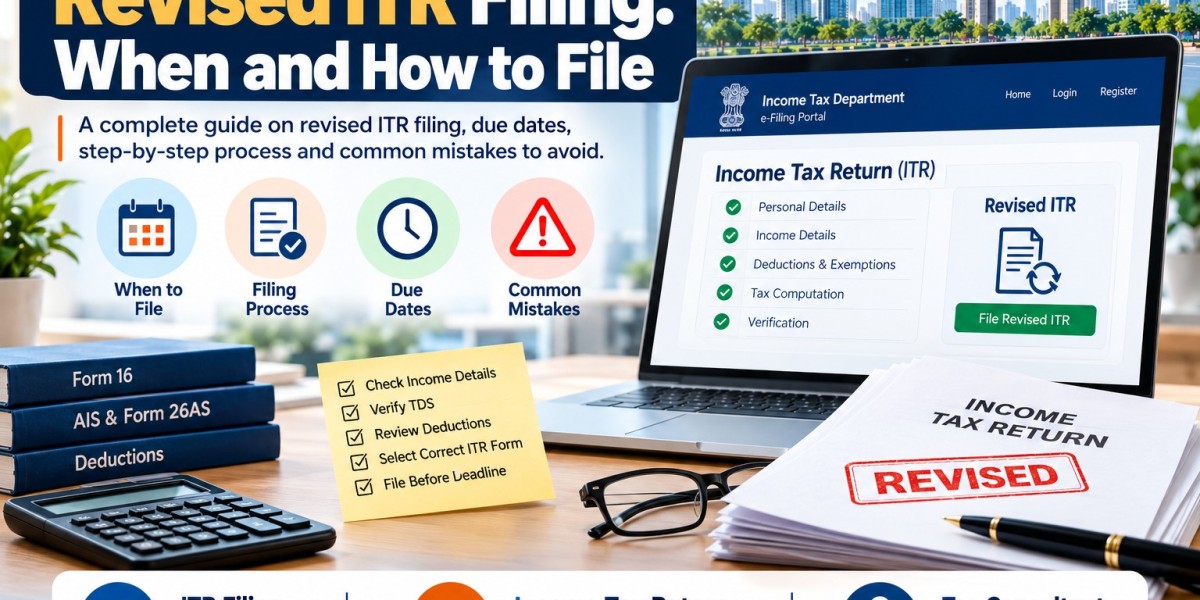

Filing an Income Tax Return (ITR) is an important annual compliance responsibility for taxpayers. However, mistakes can sometimes occur even after submitting the return. You may discover that you forgot to report income, entered incorrect information, missed eligible deductions, or made an error while reporting TDS or other financial details.
In such situations, taxpayers may be able to file a revised ITR to correct the information in the original return.
This guide explains when a revised ITR can be filed, who can file it, the process involved, common mistakes, and how professional assistance can help with ITR Filing in Noida.
What Is a Revised ITR?
A revised ITR is a corrected version of an income tax return that has already been filed.
Under Section 139(5) of the Income Tax Act, a taxpayer who has filed a return and subsequently discovers an omission or an incorrect statement can revise the return within the applicable time limit. For AY 2026-27, the Income Tax Department states that the revised return can be filed before the expiry of the relevant assessment year or completion of assessment, whichever is earlier.
A revised return is therefore useful when you identify an error after submitting your original ITR.
Why Do Taxpayers File a Revised ITR?
There can be several reasons for revising an income tax return.
Common examples include:
- Income was not reported correctly.
- Interest or dividend income was missed.
- TDS details were incorrect or incomplete.
- Bank or financial information was entered incorrectly.
- Eligible deductions were missed.
- Capital gains were reported incorrectly.
- Incorrect ITR form was selected.
- Foreign income or assets were not properly reported where applicable.
- Information in AIS or Form 26AS was not properly reconciled.
- There was a calculation or data-entry mistake.
A taxpayer should review the original return carefully before filing a revised return to make sure all relevant information is corrected.
Who Can File a Revised ITR?
Generally, a taxpayer who has already furnished an eligible original or belated return can revise it within the prescribed time and subject to the applicable provisions.
The revised return is not meant to replace the original filing immediately. Instead, it is filed as a correction to the earlier return.
Taxpayers should also understand that a revised return is different from an Updated Return (ITR-U). The appropriate option depends on the circumstances, timing, and nature of the correction.
Revised ITR Deadline for AY 2026-27
For AY 2026-27, the Income Tax Department states that a revised return can be filed up to 31 March 2027, or before completion of assessment, whichever is earlier.
There is an important additional consideration for AY 2026-27. If the revised return is filed after 31 December 2026, additional fees under Section 234-I may apply. The Income Tax Department's current guidance specifies ₹1,000 where total income does not exceed ₹5 lakh and ₹5,000 where total income exceeds ₹5 lakh.
Therefore, taxpayers should not unnecessarily wait until the final date to correct an error.
How to File a Revised ITR
The general process for filing a revised ITR involves the following steps.
Step 1: Identify the Error
First, compare the filed ITR with your financial records. Check salary, business income, interest, capital gains, deductions, TDS, advance tax, and other relevant information.
Step 2: Check AIS and Form 26AS
Review information available in the Annual Information Statement (AIS) and Form 26AS. Compare the information with your own records and identify discrepancies.
Step 3: Select the Correct ITR Form
The revised return should generally use the appropriate ITR form applicable to your circumstances.
Selecting the correct form is important because different taxpayers may have different income sources and reporting requirements.
Step 4: Use the Original Return Details
While filing the revised return, you will generally need information relating to the original return, including the original acknowledgement details and the applicable filing section.
Step 5: Correct the Information
Enter the correct income, deductions, TDS, tax payments, and other applicable details. Do not change unrelated information without reviewing it carefully.
Step 6: Calculate the Revised Tax Liability
After making corrections, review the resulting tax liability or refund. If additional tax becomes payable, ensure that the applicable tax and interest are properly considered.
Step 7: Submit and E-Verify
Submit the revised return through the income-tax e-filing system and complete the applicable verification process. E-filing and e-payment are separate processes, so taxpayers should ensure that any tax payable is properly paid.
Does a Revised ITR Replace the Original ITR?
Yes, the revised return becomes the relevant corrected return for processing, subject to the applicable provisions and successful filing.
However, taxpayers should retain records of both the original and revised filings, including acknowledgement numbers and supporting documents.
Keeping these records can be useful if there is a future query, notice, or discrepancy.
Common Mistakes While Filing a Revised ITR
1. Missing Additional Income
Taxpayers sometimes correct one mistake but forget other income sources such as bank interest, dividends, freelance income, rental income, or capital gains.
2. Not Checking AIS and Form 26AS
Failing to reconcile tax information can result in discrepancies between the return and information reported by financial institutions or deductors.
3. Claiming Incorrect Deductions
Only eligible deductions should be claimed. Supporting documents should be retained for the claims made in the return.
4. Choosing the Wrong ITR Form
Selecting an inappropriate ITR form can create filing and processing problems.
5. Waiting Until the Last Date
Although a revised return may be available until the applicable deadline, waiting until the last moment increases the risk of technical issues, missing information, or additional compliance costs.
6. Forgetting to Verify the Return
After submission, taxpayers should complete the applicable verification process. An unverified return may create problems with processing.
ITR Filing in Noida
Individuals and businesses looking for ITR Filing in Noida should maintain proper financial records throughout the year rather than preparing everything only at the time of filing.
Salaried employees should keep Form 16, investment records, interest income details, TDS information, and other relevant documents. Business owners and professionals may need additional records relating to turnover, expenses, books of accounts, and business income.
A proper review before filing can reduce the possibility of having to revise the return later.
Income Tax Return Filing in Noida
Professional support for Income Tax Return Filing in Noida can be useful when taxpayers have multiple income sources, business income, capital gains, foreign transactions, significant deductions, or discrepancies between their records and tax statements.
A professional can review the information before filing and help identify potential reporting errors.
How a Tax Consultant in Noida Can Help
A Tax Consultant in Noida can assist with reviewing the original ITR, identifying discrepancies, reconciling AIS and Form 26AS information, checking deductions, calculating tax liability, and preparing a revised return where appropriate.
TaxCaller provides income-tax and compliance support for individuals and businesses, including ITR filing, tax planning, TDS reconciliation, and related tax services.
Professional review can be particularly valuable when the correction involves multiple income sources, capital gains, business income, or substantial tax implications.
Revised ITR vs Updated ITR
A revised return and an updated return are not the same.
| Basis | Revised ITR | Updated ITR |
|---|---|---|
| Purpose | Correct an error or omission in an eligible filed return | Make specified corrections/additions under the updated-return provisions |
| Timing | Within the applicable revised-return period | Subject to separate statutory time limits |
| Common use | Correcting information in an already filed return | Reporting additional income or correcting certain omissions after the revised-return window |
| Additional tax | Depends on circumstances | Additional tax requirements can apply |
Taxpayers should determine which type of return is legally appropriate before filing.
Conclusion
A revised ITR provides taxpayers with an opportunity to correct eligible mistakes in an already filed income tax return. Errors involving income, TDS, deductions, capital gains, or other information should be identified and corrected as soon as possible.
For AY 2026-27, the revised-return window extends to 31 March 2027, subject to the applicable conditions, while additional fees can apply for revisions filed after 31 December 2026.
Whether you need ITR Filing in Noida, Income Tax Return Filing in Noida, or assistance from a Tax Consultant in Noida, careful review of your tax information before and after filing can help maintain accurate tax compliance.
Note: Income-tax rules, forms, deadlines, and applicable fees may change through legislation, notifications, or circulars. Taxpayers should verify the current requirements applicable to their assessment year before filing.