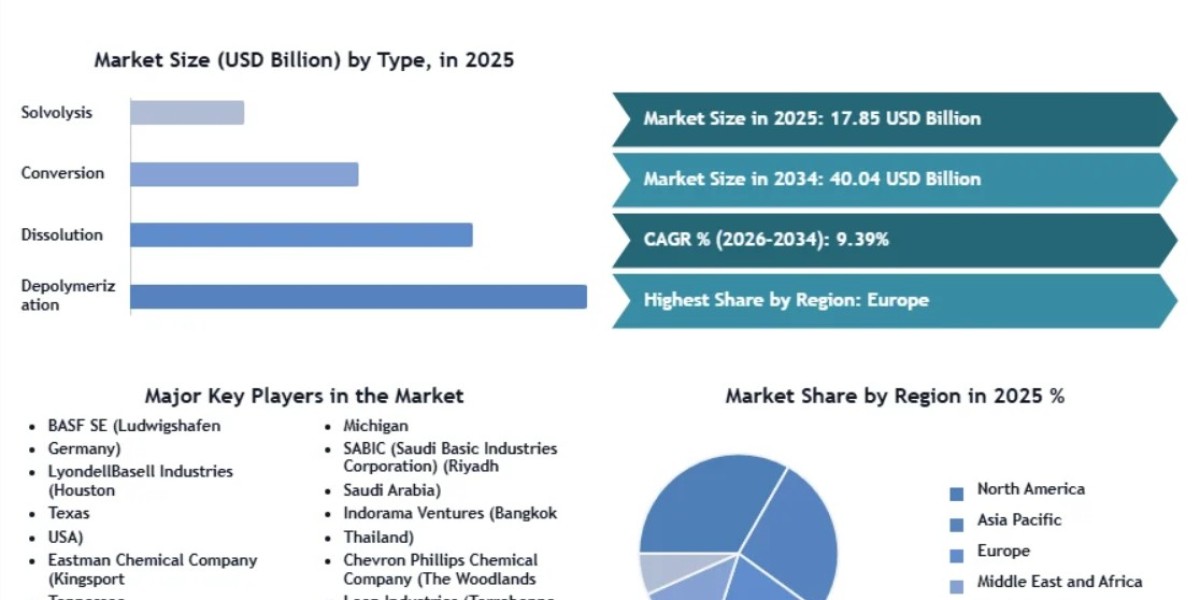

The global Chemical Recycling of Plastics Market was valued at USD 17.85 billion in 2025 and is projected to expand at a Compound Annual Growth Rate (CAGR) of 9.4% through 2034, reaching nearly USD 40.04 billion by the end of the forecast period, according to a comprehensive market intelligence study by Stellar Market ResearchStellar Market Research. As structural limitations in mechanical recycling continue to stall corporate zero-waste commitments, advanced chemical recycling technologies—such as pyrolysis, gasification, depolymerization, and hydro-cracking—are emerging as the primary industrial solution for processing hard-to-recycle, multi-layered, and contaminated post-consumer plastic waste streams into virgin-grade polymers.
The global petrochemical and plastics value chain is undergoing a fundamental structural transition. Historically, post-consumer plastics were viewed as municipal liabilities suitable primarily for landfills or energy recovery via incineration. However, escalating regulatory pressure—most notably the European Union’s mandate enforcing a 10% landfill limit for municipal waste alongside 55% plastic packaging recycling targets by 2034—has transformed plastic waste into a strategically critical raw material feedstock.
Key Findings from the Report
Market Valuation: The global Chemical Recycling of Plastics Market is expanding from USD 17.85 billion in 2025 to USD 40.04 billion by 2034, reflecting a 9.4% CAGR.
Dominant Technology Segment: Pyrolysis and Gasification constitute over 80% of planned commercial capacity, serving as the dominant feedstock recycling pathways due to their ability to process mixed polyolefin waste streams (PE and PP).
Primary End-Use Industry: The Packaging Sector remains the largest single consumer of chemical recyclates, driven by FMCG consumer commitments to integrate ISCC+ certified post-consumer recycled (PCR) content into flexible films and food-contact containers.
Fastest-Growing Segment: Depolymerization (Solvolysis/Enzymatic) technology is experiencing accelerated growth in PET and nylon applications, allowing targeted monomer recovery with lower energy intensity.
Capital Deployment Escalation: Global infrastructure expenditure for chemical recycling capacity is projected to triple, rising from USD 2.87 billion (2025) to USD 8.83 billion (2034).
Yield & Environmental Impact: Modern proprietary technologies (e.g., LyondellBasell’s MoReTec) demonstrate significant net reductions in greenhouse gas (GHG) emissions compared to traditional fossil-based naphtha cracking and incineration options.
For further information, click the following link:https://www.stellarmr.com/report/req_sample/chemical-recycling-of-plastics-market/2432
Market Drivers and Restraints
Market Drivers
Regulatory Mandates & Mandatory Recycled Content Targets: Strict enforcement of circular economy framework policies across Europe, North America, and parts of Asia-Pacific—such as recycled packaging content thresholds and plastic tax penalties—is compelling plastic producers to secure long-term chemical recyclate off-take agreements.
Inability of Mechanical Recycling to Process Complex Waste: Over 67% of European post-consumer plastic waste historically ended up in landfills or energy recovery due to contamination, colorants, and multi-layer packaging structures. Chemical recycling solves this bottleneck by accepting mixed, unwashed waste streams.
FMCG and Brand Owner ESG Commitments: Top-tier consumer packaging brands require virgin-equivalent materials for food safety compliance. Chemical recycling remains the only scalable method to generate circular polymers that meet stringent food-contact standards.
Market Restraints
High Capital Expenditure and Technology Scale-Up Risks: Building commercial-scale pyrolysis and gasification plants requires significant upfront capital investments, while continuous operational reliability at industrial scale remains a technical hurdle for early-stage operators.
Feedstock Aggregation and Sorting Supply Chain Bottlenecks: The lack of standardized waste collection infrastructure limits the supply of consistent, high-yield plastic feedstock, causing operational inefficiencies and yield volatility at recycling plants.
Technology, Regulation, and Sustainability Trends
Industrial adoption is closely tied to mass-balance accounting protocols and ISCC PLUS (International Sustainability and Carbon Certification) certifications. By certifying chemical recycling feedstocks through existing steam crackers, chemical manufacturers can allocate circular content to specific output batches without rebuilding infrastructure.
Concurrently, artificial intelligence (AI) and automated optical sorting systems are being integrated into pretreatment facilities to remove non-plastic contaminants (such as PVC and halogenated compounds) before pyrolysis processing, protecting catalyst life and maximizing liquid oil yields.
Regional Insights
Europe (Leading Region): Europe commands the largest market share in chemical recycling technologies and capacity deployment. Driven by the European Green Deal, the Circular Plastics Alliance (targeting 10 million tons of recycled plastics in European products), and national plastic packaging taxes (e.g., in Spain and the UK), Western European nations are rapidly scaling commercial projects. Spain alone accounts for over 465,000 tonnes per year of planned chemical recycling capacity across major industrial players like Repsol, TotalEnergies, and Plastic Energy.
North America & Asia-Pacific (Emerging Regions): North America is experiencing rapid capacity additions led by Gulf Coast chemical hub integrations (such as BASF’s Texan facilities and NOVA Chemicals’ circularity initiatives in Canada). Meanwhile, Asia-Pacific represents the fastest-growing volume market, propelled by domestic waste management legislation in Japan, South Korea, and China, alongside expanding regional industrial demand for sustainable export packaging.
Recent Industry Developments
NOVA Chemicals (2025): Launched its Centre of Excellence for Plastics Circularity in Canada, establishing a joint research and development hub focused on scaling commercially viable advanced recycling technologies across North American value chains.
BASF (2025): Expanded its commercial ChemCycling™ project to its Port Arthur, Texas facility, producing ISCC+ certified, advanced recycled feedstock-derived products used in high-performance applications like superabsorbent polymers and engineering plastics.
LyondellBasell (2024): Commenced construction on its first industrial-scale MoReTec chemical recycling plant at its Wesseling site in Germany, featuring a 50,000-tonne capacity designed to process the plastic waste generated by 1.2 million citizens annually.
Saipem & Garbo (2024): Entered a strategic agreement to commercialize ChemPET depolymerization technology, building Italy’s first industrial-scale chemical recycling plant in Cerano to convert difficult PET waste into high-purity virgin-grade PET.
Repsol / Enerkem / Agbar (2025): Advanced a major industrial-scale waste gasification project in Spain designed to process up to 400,000 tonnes of non-recyclable municipal solid waste annually into circular chemical building blocks.
Competitive Landscape
The chemical recycling landscape is characterized by strategic alliances between technology licensors, petrochemical producers, and waste management operators. Leading players are moving away from standalone pilot projects toward joint ventures integrated directly into existing refining and petrochemical complexes.
Key Industry Players Include:
BASF SE
LyondellBasell Industries N.V.
Repsol S.A.
TotalEnergies SE
Plastic Energy
SABIC (Saudi Basic Industries Corporation)
Eastman Chemical Company
Agilyx AS
Enerkem Inc.
Honeywell UOP
Analyst Commentary
"Chemical recycling is no longer an experimental R&D initiative—it has matured into a core strategic hedge for global petrochemical producers facing long-term carbon constraints," stated a Senior Research Analyst at Stellar Market Research. "As regulatory bodies firm up mass-balance standards and brand owners demand virgin-quality circular resins, companies that secure continuous waste-feedstock supply chains and scale thermochemical conversion facilities today will dominate the global plastics economy over the next decade."
Future Outlook
Over the 2026–2034 forecast horizon, the market is expected to shift toward integrated circular hubs where waste processing, pyrolysis oil refining, and polymer synthesis take place within unified industrial ecosystems. As chemical recycling capacity moves toward the 2.8 million-ton production threshold by 2034, regulatory standardization around life-cycle assessment (LCA) methodologies and mass-balance accounting will play a decisive role in determining commercial profitability and global expansion trajectories.
For further information, click the following link:https://www.stellarmr.com/report/req_sample/chemical-recycling-of-plastics-market/2432
About Stellar Market Research
Stellar Market Research is a multifaceted market research and consulting company with professionals from several industries. Some of the industries we cover include medical devices, pharmaceutical manufacturers, science and engineering, electronic components, industrial equipment, technology and communication, cars and automobiles, chemical products and substances, general merchandise, beverages, personal care, and automated systems. To mention a few, we provide market-verified industry estimations, technical trend analysis, crucial market research, strategic advice, competition analysis, production and demand analysis, and client impact studies.
Address
Phase 3, Navale IT Zone, S.No. 51/2A/2, Office No. 202, 2nd floor, Near, Navale Brg, Narhe, Pune, Maharashtra 411041
Email
sales@stellarmr.com
Mobile
+91 9607365656