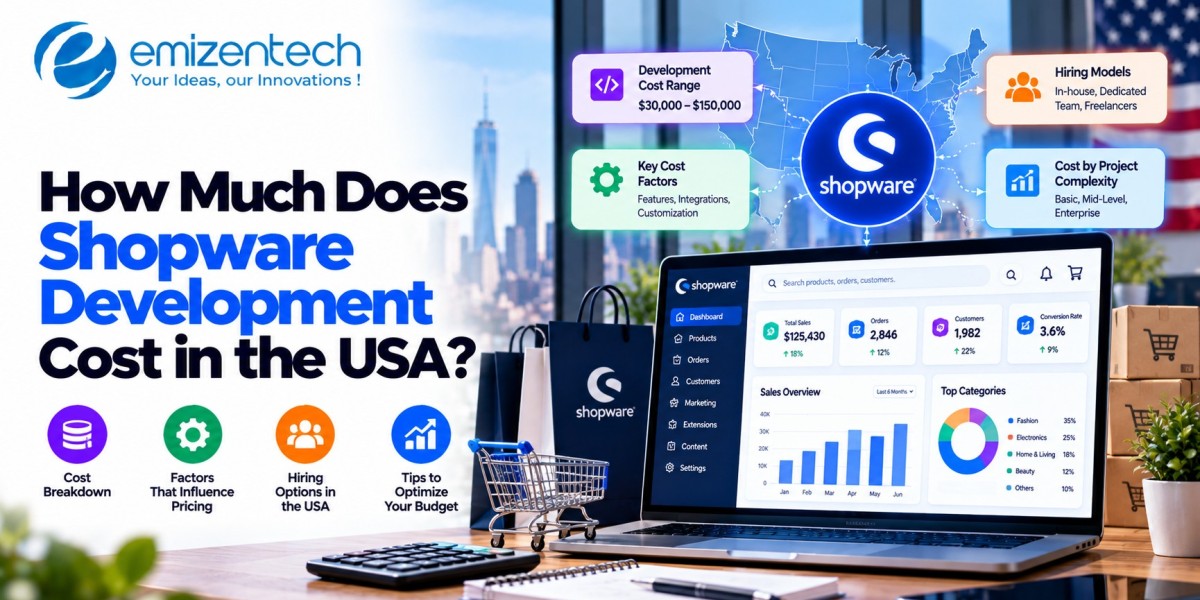

Thinking about building on Shopware and wondering what it'll actually cost? "It depends" is the honest answer, and also a useless one, so let's talk numbers. Shopware development cost in USA can start under $10,000 for a simple launch and pass $150,000 for a B2B or headless build. That's a huge spread. It exists because Shopware is open source and API-first, so you pay for how much you customize, not for a fixed package.
Below you'll find typical ranges, what pushes them up or down, the costs people forget, and a few ways to spend less. Treat every figure as a planning estimate, not a quote.
Shopware Development Cost in USA at a Glance
Most projects land in one of three bands. Find yours and use it as a starting point, nothing more.
Project type | Typical cost (USD) | Timeline |
Basic store with theme setup | $8,000 – $25,000 | 4–8 weeks |
Mid-size custom store | $25,000 – $75,000 | 2–4 months |
Enterprise, B2B, or headless build | $75,000 – $250,000+ | 4–9 months |
Timelines depend a lot on how quickly you approve designs, send content, and sign off on integrations. Delays on your side hurt just as much as delays on the developer's.
Licensing and Hosting Costs
Shopware has a free Community Edition, which is fine for smaller merchants. The paid plans add support, B2B features, and enterprise tooling. Published pricing has started around €600 a month for Rise and €2,400 for Evolve, with Beyond quoted case by case. Check Shopware's site for current rates before you lock in a budget.
Hosting is its own line. A small store on managed hosting might cost $50 to $300 a month. A busy store that needs dedicated servers, Elasticsearch or OpenSearch, and Redis caching can easily pay $1,000 or more.
Key Factors That Shape Shopware Development Pricing
No two Shopware builds cost the same. Scope, design, integrations, and who does the work all move the number. Once you understand each one, proposals get much easier to read.
Project scope and complexity
A 200-product catalog with standard checkout is a different animal from a multi-store marketplace with tiered pricing and approval workflows. Every extra workflow means more design, development, and testing hours. They add up fast.
Design and theme work
A lightly edited theme keeps costs down. A fully custom storefront, with its own Shopping Experiences layouts, animations, and brand-specific components, usually lands between $10,000 and $30,000. Sometimes more.
Custom plugins and apps
Shopware's extension system lets you change almost anything. Small jobs, like a custom shipping rule, might cost $2,000 to $6,000. Bigger modules such as subscription billing, product configurators, or loyalty programs often run $10,000 to $30,000 each. If your business needs a lot of tailoring, custom Shopware development cost climbs with every unique module you add.
Integrations
Connecting your ERP, CRM, PIM, payment, and shipping tools is the item people underestimate most. Each one usually costs $3,000 to $15,000, depending on how good the other system's API is and how much data moves between them. Payments are a good example, and our guide on payment gateway integration for ecommerce goes through the types, steps, and costs.
Data migration
Coming from Shopware 5, Magento, WooCommerce, or Shopify? You'll need data mapping, redirects, and a lot of testing. Budget $5,000 to $40,000, depending on catalog size, order history, and how much custom data you have.
Team location and engagement model
US agencies charge the most. Nearshore and offshore teams cost less per hour, sometimes a lot less.
Region | Typical hourly rate |
USA | $100 – $200 |
Eastern Europe | $40 – $80 |
India and South Asia | $25 – $50 |
Plenty of US merchants go hybrid: someone local handles strategy and product decisions, while a remote team does the engineering. It's a decent middle ground between communication and cost.
Estimated Cost by Component
Budgeting is easier when you split the project into pieces. You probably won't need everything on this list, so just pick what applies to you.
- Store setup and configuration: $2,000 – $8,000
- Theme customization: $3,000 – $20,000
- Custom plugin development: $2,000 – $30,000 per module
- ERP or CRM integration: $3,000 – $15,000 each
- Data migration: $5,000 – $40,000
- Mobile app or PWA: $15,000 – $60,000
- QA and performance work: roughly 10–20% of development cost
Hidden Costs to Plan For
The build isn't the whole bill. Plenty of expenses show up after launch or sit outside the original quote, and they tend to catch people off guard. Count them now.
- Marketplace extensions: a lot of them charge yearly license fees.
- Security and compliance: PCI DSS, accessibility rules, and privacy laws like CCPA can mean extra work.
- Upgrades: Shopware releases updates regularly, and your custom code has to be tested against each one.
- Maintenance: expect 15–20% of the build cost per year, or a retainer of $500 to $3,000 a month.
- Training and content: teaching your staff, shooting product photos, writing copy. None of it is free.
How to Keep Your Budget Under Control
Spending more doesn't automatically get you a better store. A few sensible calls on scope and timing can save you thousands.
- Launch an MVP first. Ship the core, then add fancier features once real customers tell you what they want.
- Try existing extensions before building custom. Save custom work for things that actually set you apart.
- Rank your features. Split must-haves from nice-to-haves so scope creep is easy to spot.
- Pay by milestone. Fixed-scope phases mean fewer surprises and an obvious way to track progress.
- Plan maintenance from day one. Looking after a stable store is cheaper than rescuing a neglected one.
How to Choose the Right Shopware Partner
The cheapest quote rarely ends up being the cheapest project. Look for certified developers, portfolio work similar to yours, honest estimates, and real support after launch. Ask for a breakdown by phase so you can compare proposals line by line.
It also helps to work with a team that covers the full range of shopware development services: implementation, migration, integrations, plugins, and support. Fewer handoffs means fewer places for things to slip, and you know exactly who to call. Before signing, ask who owns the code, how post-launch bugs get handled, and who deals with future updates.
Conclusion
Shopware development cost in USA comes down to scope, how much you customize, how many systems you connect, and who builds it. A basic launch usually runs $8,000 to $25,000, and a custom mid-size store $25,000 to $75,000. Enterprise projects cost more, and hosting and maintenance keep going after launch. Start with a clear scope, decide what really matters, and compare detailed proposals. If you'd like a tailored estimate, Emizentech can look over your requirements and suggest a plan that fits your budget and growth goals.
FAQs
1. How much does a basic Shopware store cost in the USA?
Usually between $8,000 and $25,000. That covers theme setup, standard checkout, and essential configuration. Catalog size, design expectations, and payment or shipping setup can push it either way.
2. How much does custom Shopware plugin development cost?
Simple plugins often run $2,000 to $6,000. Complex ones, like subscriptions, configurators, or advanced B2B tools, can reach $10,000 to $30,000 or more, depending on the logic involved and how much testing it needs.
3. What are the ongoing costs after launch?
Mainly hosting, extension licenses, security updates, and maintenance. Many merchants spend 15–20% of the original build cost each year, or $500 to $3,000 a month on a support retainer.
4. How long does Shopware development take?
A basic store can go live in 4 to 8 weeks. Custom mid-size projects usually take 2 to 4 months, and enterprise or headless builds can stretch to 4 to 9 months, depending on scope and integrations.
5. Does hiring an offshore team reduce Shopware development pricing?
Often, yes. Hourly rates can be 50% lower or more than US agencies. The savings hold up best when your requirements are well documented and you've planned for time-zone overlap and quality checks.